A last strand spanning the present with two famous Australian touring parties just after the First World War has been severed with the death of George Scott Page, just four months before his 89th birthday.
South Shields-born Page, grand old man of the Durham County Cricket Club, passed away peacefully on 20th March after a short illness in hospital in Tunbridge Wells, where he had lived since moving from Tyneside to join a dental practice there in 1926. Until just a few hours before the end, he was in good spirits, commanding centre stage as always.
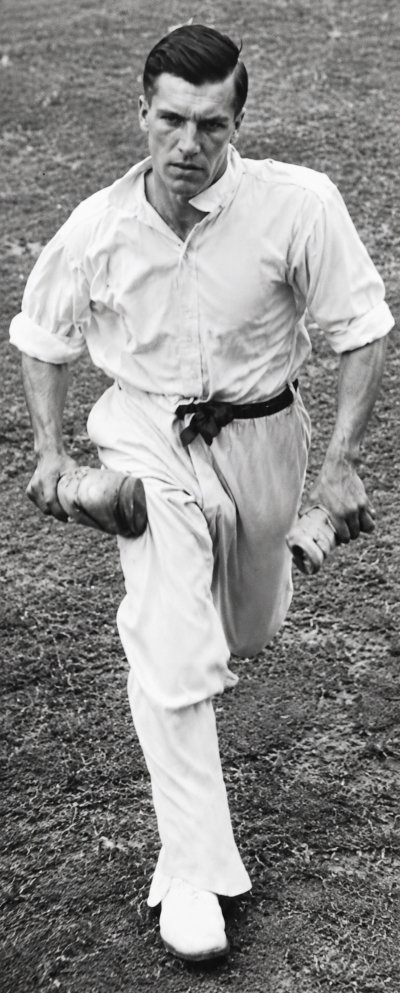
A cavalier batsman of high quality, with particularly delicious off-side shots and an audacious contempt for bowlers’ reputations, he was a superb fieldsman whose apparent languid nonchalance lured many a run-stealing batsman out of his ground—and to his doom as Page pounced like a panther.
His career suddenly blossomed in 1919 when, having got into the South Shields first XI as a last-minute replacement, he made his debut for Durham a few weeks later, also because a selected player dropped out unexpectedly. But such was his talent that he was a first choice, when available, for club and county until he departed for Kent in 1926.
In 61 innings for Durham, he scored 1,279 runs at an average of 23.68, including a dazzling 178 against Lancashire 11 at Blackhill in 1921, which remains the third-highest individual score for the county. The few who can still recall the splendour of his strokeplay will be surprised that those figures were not higher, for when on song there were few more commanding batsmen at Minor Counties level.
But Scott Page (“There never was a damned hyphen, though people insisted on sticking one in”) cared nothing for statistics, and his boldness often cost him his wicket cheaply.
But what age, however, which made him a considerable cricketing curiosity and brought him his most notable claim to fame—as almost certainly the only surviving player to have faced both sides of the Australian Imperial Forces in 1919 and Warwick Armstrong’s immortal tourists two years later.
For Durham against the AIF at West Hartlepool he had cruised to 33 when his stumps were wrecked by the second-change bowler, New South Wales giant Jack Gregory, revealing that season his devastating brand of fast bowling which—in tandem with the handsome, more artful speed of Ted McDonald—was for the next few seasons to leave England batsmen reeling.
George Scott Page remembered that brief encounter with one of the game’s legendary figures: “He was all arms and legs as he tore up to the wicket, culminating in what seemed an explosion of effort and energy and the ball was at you. It was the most unnerving and menacing experience I ever had as a batsman.”
In the county’s game against the Australians at Sunderland’s Ashbrooke ground in 1921, he scored 24 and 29, caught in the deep both times, as the all-powerful tourists—Charlie Macartney, Arthur Mailey, Bertie Oldfield, Armstrong, McDonald, et al—won easily by ten wickets.
Even in ripe old age Scott was irritated with himself for fielding to the tempting slow stuff of first, Armstrong and then Mailey, having in both innings withstood the spiteful, devious menace of McDonald. “I was always too hot-headed and I fell for the sucker punch,” he would say in self-rebuke.
He carried a mental picture of McDonald’s rhythmic grace to the end of his days. “Lindwall, Holding and Hadlee were absolute thoroughbreds,” he declared, “but that man was the prince of them all.”
Page’s departure from his home town was also a grievous blow to rugby. Displaying the same panache as a fleet-footed centre-three-quarter with local club Westoe, he was capped 22 times for Durham.
Bluemantles and Linden Park
Although he never again played sport at that level in his adopted town, he was a regular with the Blue Mantles and then Linden Park, becoming captain and chairman, and was a prime mover in wartime in introducing limited-overs cricket to the Tunbridge Wells area. His legacy of that is the long-established Courier Cup competition.
His achievement in the field of children’s dentistry won high acclaim on both sides of the Atlantic, his part in the formation of the British Paedodontic Society earning him Fellowship of the American College of Dentists in 1962. Four years later he became only the second non-citizen to be made an honorary associate member of the American Society of Dentistry.
His was a life well worth living, and with his vast experience and elephantine time memory he was an engrossing companion, normally demanding first and last say as well as most in between. Warm-hearted and generous, he nevertheless suffered fools not too well, drawing from cricket a favourite expression for them.
“Not one to spot a short single,” he would say.
Some years ago an Australian visitor came by chance to his surgery for treatment, and the two men began talking of cricket. When the stranger announced that he had played for the AIF side, Scott glanced at the appointments’ book and saw it was that former NSW fast bowler Cyril Docker.
Chuckled Page: “We had not recognised each other, and his jaw dropped when I casually replied ‘Yes, and I batted against you at West Hartlepool—but it took Jack Gregory to get me out!’
Goodbye, George Scott Page; many are glad they knew you.
Read More: Ben Hollioake