Tenacious India Turn the Second Test into a Classic Contest at Delhi in 1979
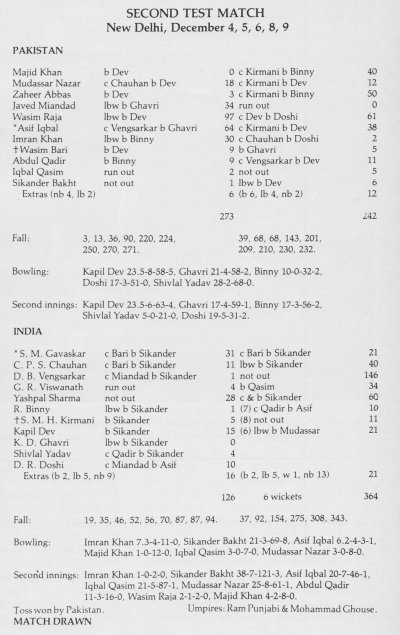
There were unmistakable echoes of last summer’s Oval Test in this enthralling encounter. India, thoroughly outplayed for much of the first four days, came within just 26 runs of victory, still holding four wickets in hand at the close. If they failed to win, it was because they refused to take even the slightest gamble in pursuit of their first Test triumph over Pakistan since November 1952. Pakistan eventually held firm against India’s late charge. Yet they might just as easily have been pushing for victory themselves—or even achieved it—had their attack not been severely weakened by Imran Khan’s breakdown early in India’s first innings.
That setback was eased considerably by Sikander Bakht, who rose magnificently to the challenge. He claimed 11 wickets in the match, including eight in the first innings. His performance stood out not only for its skill but also for its remarkable endurance. From just before lunch on the opening day until stumps, he bowled without a meaningful break, carrying Pakistan’s attack almost single-handedly. Another striking feature of Sikander’s effort was the complete lack of support from the opposite end. Even Asif Iqbal, who had initially shared the new-ball duties with him after Imran left the field, was forced to withdraw because of illness.
In earlier Test matches at Delhi’s Feroz Shah Kotla, the ball had often swung dramatically. Geoff Arnold masterminded England’s victory there in 1972–73, while John Lever, on his Test debut four years later, also wreaked havoc at the venue. Yet it is difficult to recall another recent Test in India that had been so overwhelmingly dominated by pace and seam bowling. Of the 36 wickets to fall, only three were taken by spinners, and it was not until the final day that the batsmen found any real comfort. Even that was probably because the tireless Sikander Bakht finally began to tire.
The pitch’s appearance on the eve of the match proved deceptive. There was very little grass. Earlier, Pakistan had reached 348 for 7. Although they lost momentum toward the end of the innings, the determined resistance from Wasim Bari and the tailenders enabled them to build a substantial total—enough to put India under pressure and force them to begin their reply during the final hour of the second day.
Once Chauhan was dismissed for 17, India never truly looked in trouble as they steadily progressed to 416. Gavaskar and Viswanath, with innings of 88 and 73 respectively, were the chief architects of the recovery. They scored at a more measured pace than Pakistan, but the slow, turning surface posed greater problems than it had during at least the first half of the visitors’ innings.
One of the highlights of India’s batting effort was the debut of Roger Binny, the 25-year-old all-rounder. Although he had bowled without much impact after a nervous start, he displayed impressive composure with the bat, compiling a confident 46. His defence was solid against both pace and spin, and whenever he chose to attack, Binny struck the ball with tremendous authority.
Tempted into hooking a short delivery, Binny eventually became one of four wickets claimed by Imran Khan—a respectable return given that the dry, shaved surface offered virtually no bounce. The early impression was that, on typical Indian pitches, both teams would struggle to force a result within five days of five-and-a-half hours of play. The gap between the two sides had narrowed considerably since their previous meeting a year earlier, with Pakistan particularly feeling the absence of Sarfraz, one of the principal contributors to their earlier success.