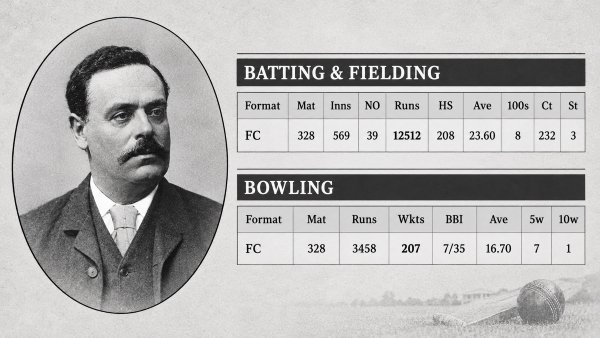
Ephraim Lockwood, Yorkshire, 1845–1921
Lascelles Hall was once a small village three miles from Huddersfield, an unassuming corner of industrial England whose few inhabitants were known for their dedication to weaving at cottage handlooms. Yet this modest community would earn a lasting place in cricket history by producing the nucleus of some of Yorkshire’s earliest teams. If Hambledon was regarded as the cradle of cricket, Lascelles Hall was Yorkshire’s celebrated nursery, producing no fewer than twenty-one players for the county.
From an early age, village youngsters were expected to help operate the looms. Equally important, however, was their rigorous training on the cricket ground, picturesquely situated on a hill. Most played barefoot, and with educational opportunities limited, they devoted practically all their spare time at midday and in the evenings to organized practice. Every player bowled forty balls, and every batsman received an equal share. When the wickets changed ends, fielders rotated through new positions, throwing catches to one another while they waited. Any batsman who managed to face more than his allotted forty balls was fined a penny!
In such a close-knit community, most families were connected through marriage. Names such as Bates, Eastwood and Thewliss became familiar throughout Yorkshire county cricket. Indeed, it was said that many Lascelles Hall cricketers modeled their technique on John Thewliss, making their style instantly recognizable. It was into this cricket-mad community that Ephraim Lockwood was born on April 4, 1845.
Debut at the Oval
The eldest of four children, Lockwood had to fend for himself from the age of thirteen. Like many other village boys, however, he progressed through the practice routines more quickly than most. He possessed an exceptional gift for batting, a talent that would establish him among England’s leading batsmen for fifteen years.
Lascelles Hall had already demonstrated its strength by defeating the Yorkshire side and Harry Jupp’s XI, which was virtually the full Surrey team. An especially impressive achievement came in 1867, when the village team defeated the All England XI by six runs.
Ephraim Lockwood first major opportunity arrived at the beginning of the 1868 season, when he was invited to play for the Colts of England at Lord’s. Travelling so far from home may have unsettled the young batsman and contributed to his failure with the bat. Yet another, far more exciting opportunity was just around the corner.
During an August weekend that same year, Yorkshire traveled south to face Surrey at the Oval, with the match scheduled to begin on Monday. Following a bus accident at Derby, Yorkshire lost the services of George Freeman and Luke Greenwood. After a hurried consultation involving Tom Emmett and John Thewliss, the decision was made to summon Thewliss’s nephew, Ephraim Lockwood.
The young recruit arrived at the ground with his cricket clothes wrapped in an old newspaper. The Oval crowd could scarcely contain its amusement at his slight, undernourished appearance, tight trousers and shirt patterned with red, green and black squares.
After dismissing Surrey for 195, his uncle, John Thewliss, took Lockwood in to open the Yorkshire innings. As the pair put together an opening partnership of 176, the spectators’ initial ridicule gradually gave way to admiration. Lockwood was the first to fall, having scored 91, while Thewliss continued to 108. Yorkshire’s final total was enough to secure victory by an innings and 142 runs.
The spectators had taken the composed young batsman to their hearts. As he left the wicket, they hurried to form a tunnel so they could get a closer look at him. One Londoner remarked that he “looked fitter to eat a penny cake than play cricket!”
The Reverend R. S. Holmes, a chronicler of early Yorkshire cricket, described Lockwood that day as “looking all over an anointed clodhopper.” The teasing may well have reminded John Thewliss of his own county debut, when the hard-bitten Yorkshiremen had roared for him to remove his jacket while batting. He dared not do so because of the holes in his shirt.
Lockwood’s success was questioned by I. D. Walker, the distinguished England and Middlesex batsman, who argued that the result might have been different had Surrey’s fast bowler, Southerton, been playing.
Perhaps Lockwood provided the perfect answer to that criticism the following year, when the same fixture brought him scores of 103 and 34 not out, with Southerton in the opposition. His outstanding performance left little room for doubt about his ability. Cricket, however, can be a cruel game: the following Saturday, in a club match, a lob bowler dismissed him round his legs for a duck!
His favorite shot — the cut
Lockwood was of average height and build, but his broad shoulders and large feet did little to make him a natural athlete. One female spectator even suggested that he might run faster if he wore smaller boots!
What he lacked in athleticism, however, he more than made up for with his excellent eye. His favourite scoring stroke was the cut, both fine and square, and he relished playing it powerfully even to balls pitched on middle stump. Opposing captains sometimes went to considerable lengths to counter the shot, positioning two or three men to guard against it, yet Lockwood’s placement was remarkably precise.
On rough wickets, he displayed impressive defensive technique, using a remarkably straight bat and exercising almost inexhaustible patience. Slow bowlers, meanwhile, were often punished with lofted drives soaring over their heads.
Even before the turn of the twentieth century, batsmen were increasingly inclined to leave deliveries outside the off stump. This habit greatly irritated Lockwood, who would often remark, “I would have given two shillings a dozen for them!”
Nicknamed — Old Mary
Like many people raised in similarly modest circumstances, Lockwood was somewhat slow on the uptake and often became the target of practical jokes, some playful and others decidedly unkind. He resented such treatment in his youth, although, looking back, he came to accept it as part of growing up.
Another of life’s minor irritations arrived in the form of an enduring nickname. During a match between a United North XI and a local Leeds XXII, George Freeman, Yorkshire’s particularly handsome fast bowler, called out to Lockwood at point after a hard-hit shot had travelled in that direction.
“Look alive, Old Mary Ann!”
The name stuck. As the years passed, his cricketing colleagues shortened it to “Old Mary”.
Despite the constant ribbing, Lockwood remained the quiet, unassuming man he had always been. Old Ebor, interviewing the Yorkshire star for a chapter in his book Old English Cricketers, remarked on how difficult it was to persuade him to speak about himself. Asked about his experiences, Lockwood initially offered the modest reply, “Nay, I have nowt to say.” After several cautious attempts, however, the interviewer managed to draw out more of his story.
This good-natured man was happily married to a niece of Fuller Pilch. By Lockwood’s own admission, she knew more about cricket than he did!
“Old Mary” represented many of the leading club sides around Huddersfield, as county fixtures and other top-class matches were far less frequent than they are today. His popularity as a Yorkshire professional was immense, and it was hardly surprising that the captaincy was eventually offered to him.
He took over from J. Rowbotham in 1876 and remained in the position until Tom Emmett succeeded him in 1878. The county side was then so loosely organised that none of its easy-going captains found it particularly easy to keep their teammates under control. Although Lockwood lacked the forceful personality required for strong leadership, as Martin Hawke would later demonstrate in 1883, there was no question that he was Yorkshire’s leading batsman until the arrival of George Ulyett.
Lockwood scored nearly 8,000 runs for Yorkshire, including six centuries and thirty-seven innings of fifty or more. By modern standards, these figures might not appear extraordinary. Given the comparatively small number of matches played during his era and the difficult, often uneven wickets of the time, however, his record was remarkable.
208 run out of 297 v Kent
Among Ephraim Lockwood many outstanding innings for Yorkshire, two stood out for their record-breaking significance.
His opening partnership with John Thewliss at the Oval remained a Yorkshire first-wicket record until 1897, when Brown and Tunnicliffe established a new mark of 378 against Sussex at Sheffield.
The second memorable performance came during an extraordinary match against Kent at Gravesend in 1883. According to Wisden, Lockwood went in shortly before lunch and was dismissed at around six o’clock after scoring 208 of the 297 runs made while he was at the wicket. Kent subsequently managed just 148 and 150, losing by an innings and 94 runs.
Lockwood’s 208 remained the highest individual score by a Yorkshire batsman until Robert Peel scored 210 in 1896.
Reflecting on his innings afterwards, “Old Mary” offered this characteristically straightforward assessment: “Self praise is no recommendation; all the same I may be allowed to say that it was the finest innings I ever saw!”
Sadly, that remarkable burst of scoring at Gravesend was followed by a disappointing turn in his fortunes. A sudden loss of form led to his being dropped by Yorkshire, making the venue seem an ill omen.
When Old Ebor asked which innings had given him the greatest pleasure, Lockwood immediately recalled his 73 against Lancashire at Bramall Lane in 1881. His face brightened as he remembered ‘Monkey’ Hornby’s unsuccessful efforts to plug the gaps on the off side, where Lockwood’s penetrating strokes repeatedly found their mark.
The Oval remained his favourite ground throughout his career. Its “peculiar light”, he felt, seemed to suit his batting, a curious preference for a batsman from the north of England.
After his first two years, his record there and elsewhere included 67 not out for the North in 1871; 121 against Surrey in 1872, scored in three hours without giving a chance; and 67 not out and 48 for the Players in 1874. He followed these performances with 78 against Surrey in 1876, scores of 97 and 20 for the Players in 1877, 62 for the Players in 1881, and 50 against Surrey in 1882.
Such a lengthy catalogue of scores might ordinarily become tiresome, but these figures reveal just how eagerly Lockwood returned to the Oval.
The Gentlemen v Players match at the same ground in 1873 produced a pair of disappointments, as Lockwood was dismissed for a duck in each innings, much to W. G. Grace’s amusement. Grace caught him off Buchanan’s bowling in the first innings and then caught and bowled him in the second. That was also the year Lockwood missed a considerable amount of cricket because of mild sunstroke, which may help explain the setback.
The damp, overcast summer of 1877 proved especially productive for him. Lockwood and W. G. Grace were the only two batsmen that season to score a thousand runs.
Rain again played a significant part in Lockwood’s benefit match, when Yorkshire faced Lancashire at Sheffield in 1882. The poor weather severely curtailed the play and reduced the proceeds. As a result, the beneficiary received only £591, considerably less than the amount that might otherwise have been raised.
Twenty-eight times — A Player
Lockwood first represented the Players in 1869 and appeared for them on another twenty-seven occasions before 1883. Across his appearances, he accumulated nearly 1,200 runs, often scoring at a brisk rate and contributing a substantial share of his side’s total.
In the Players’ only innings of 180 in 1871, he scored 76. His magnificent 67 not out at the Oval in 1874 earned him the distinction of becoming the first batsman to carry his bat through an innings in the fixture since it began in 1806.
During the Lord’s match the following week, Allan Hill, Lockwood’s fellow player and fellow villager, completed a hat-trick, another first in the fixture.
At Lord’s in 1875, Lockwood scored 67 of the Players’ second-innings total of 165. The following year, at Prince’s, he struck 70 in their first innings of 158.
Towards the latter part of his career, he increasingly found himself batting in the middle order rather than opening.
Round Arm Bowler
Relatively little was recorded about Lockwood’s high-action, round-arm bowling, but his tally of 141 wickets for Yorkshire demonstrates that he was a useful contributor with the ball.
In 1872, he once bowled unchanged throughout both innings of the United North’s match against the United South at Bishop’s Stortford.
Perhaps his most notable contribution in county cricket came against Nottinghamshire at Trent Bridge in 1870. His slow-medium cutters claimed Nottingham’s final wicket, securing victory in the last over. Lockwood had bowled the preceding over as well, taking a wicket, but captain Iddison lacked the confidence to entrust the final over to the sometimes wayward Tom Emmett. Such an unusual arrangement was permitted under the practices of the time.
Born and raised in the countryside, Lockwood enjoyed a tankard of ale, though he was never known to indulge excessively. His dislike of water, particularly seawater, was probably the principal reason he declined several invitations to tour Australia.
Both Gregory and Spofforth recalled the disappointment of Australian cricket followers when “Old Mary” refused to join tours during the 1870s. His reluctance to undertake a sea voyage stemmed partly from his unsuccessful attempts to become a sailor and partly from the persistent rheumatism that troubled him.
Australian admirers rated Lockwood second only to W. G. Grace. This was a striking assessment, especially considering that he recorded four ducks in two matches against the touring Australians during a single week in 1882. Perhaps they had witnessed enough of his abilities on other occasions to appreciate his true worth.
His dread of sea travel was evident even when he ventured into the water for an ordinary swim. In Recollections and Reminiscences, Lord Hawke recalled a visit to Scarborough during which Lockwood went bathing with a stout rope looped around his chest and securely fastened to a bathing hut.
After covering himself with soap and making a few hurried dips to rinse it away, the reluctant swimmer promptly returned to the safety of dry land!
Old Mary visits North America
When Richard Daft selected his team to tour North America in the autumn of 1879, the inclusion of Lockwood’s name must have caused a minor stir throughout the cricket fraternity. How the tour captain persuaded “Old Mary” to accept the invitation was never revealed, but Lockwood must have had second thoughts after enduring a brutally rough, seven-day crossing from Liverpool to Canada.
George Pinder, Yorkshire’s wicketkeeper, became Lockwood’s constant companion. The other members of the touring party were amused by the pair’s customary walking arrangement: one would be a few yards ahead of the other, yet both would continue an ordinary conversation as though nothing were unusual.
When the party stood gazing at the magnificent Niagara Falls, Pinder asked Lockwood what he thought of the spectacle. Completely unmoved, Lockwood drawled, “Nowt at all. If this is Niagara, give me Sheffield any day!”
Tom Emmett’s version of the story substituted Lascelles Hall for Sheffield. Unconvinced by Lockwood’s apparent indifference, Pinder asked whether the millions of gallons of water cascading over the edge did not inspire him.
“I see nowt to stop it!” replied the unimpressed Yorkshireman.
Lockwood frequently expressed his desire to return home as soon as possible, and perhaps never more so than when swarms of mosquitoes tormented the touring party in America. Few players escaped the insects, but Lockwood suffered particularly badly, with his face becoming grotesquely swollen and distorted.
His condition was so severe that, when the team photograph was taken in Philadelphia, he had to sit at an angle so the photographer could capture his better side!
During this uncomfortable spell, he endured a sequence of scores of 0, 0, 10, 0 and 0. Fortunately, he soon recovered his touch, scoring a welcome 60 and 88 in Philadelphia and climbing towards the top of the tour’s batting averages.
Lockwood’s customary rustic naivety was also tested during a Sunday morning church service. His teammates watched with interest as the collection plate approached. The Yorkshireman’s solution was simple: he promptly fell into a deep sleep until the plate had passed safely beyond him!
Dispensed with — 1884
When Yorkshire decided to dispense with Lockwood’s services after just six matches in 1884, many observers considered the decision premature.
A review of his record offered ample reason for their reservations. He had scored one double century, seven centuries and passed fifty on fifty-seven occasions. In three separate seasons, he had also exceeded 1,000 runs.
The prospect of playing for another county rather than his beloved Yorkshire was one he never seriously entertained. Lockwood therefore announced his retirement immediately.
He did, however, appear once more for Yorkshire in a less important fixture against the Gentlemen of Scotland at Edinburgh in 1888, scoring 32 in the county’s only innings.
With less exercise, Lockwood gradually became more rotund. Taking over a sports shop, then commonly described as an athletic outfitters, nevertheless helped him maintain contact with his sporting friends.
Ephraim Lockwood died at Huddersfield on December 19, 1921, aged seventy-six. Yorkshire had lost one of its most popular professionals, and cricket had lost one of the leading batsmen of his generation. Yet the public never forgot him.