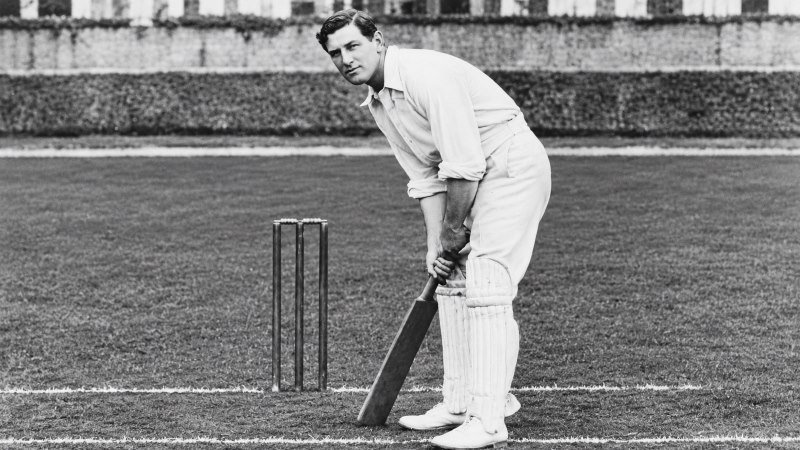
S. M. J. Woods became one of the few men to play cricket for both Australia and England, lead Somerset, and cap 13 times in rugby.
The five Woods brothers made the daily trip to Sydney’s Royston College aboard a steamer that crossed Manly Beach from across the harbor. Being active, energetic boys, they naturally loved sports, and each journey provided an informal boxing lesson from one of the tall, dark deckhands. Stepping away from his usual duties of hauling ropes, the man would drop to one knee so each ambitious young fighter could try his best to land a punch. The brothers always looked forward to reporting these sessions to their boxing instructor, Larry Foley, who carefully watched the agile young athlete in action. Foley predicted he would make his pupil champion of Australia within a year. However, Peter Jackson proved his teacher wrong by accomplishing the feat in just six months. Years later, Sammy Woods—one of the brothers—watched with excitement as Jackson defeated fellow Australian Frank Slavin to capture the World Heavyweight Championship in London in 1892.
Born at Glenfield, near Sydney, in 1867, Samuel Moses James Woods attended Sydney Grammar School before advancing to Royston College. In more senior circles, he excelled at cricket, making 1883 a standout year by claiming 70 wickets at an average of five runs each. On one occasion, he took seven wickets in seven balls. That same year, he moved to England, enrolling at Brighton College in 1885 alongside his younger brother, H. D. L. Sammy thought he came from a family of 13 or 14 children. He is still remembered as one of the fastest schoolboy bowlers of all time, and along with G. L. Wilson, he stood out among the Public School cricketers of his era. In his first year, he captured 78 wickets, and the following season, the batsmen of Lancing College were all dismissed by Sammy in a single match.
The natural progression for Sammy Woods was to head straight to university, but his path was temporarily delayed while he made a brief, unsuccessful attempt to master banking. His failure to gain a foothold in that field was likely due to his frequent absences to play cricket. While continuing on to university after such a formidable early education seems obvious now, there were good reasons for reconsideration at the time. Going up to Jesus College, Cambridge, in 1888, he earned his Blue within a few weeks, capped by a hat-trick in the game against C. I. Thornton’s XI. It proved to be a busy season: he was called to play his first Gentlemen vs Players match at Lord’s, where he took ten wickets for 76 runs. Although Oxford University was saved by rain, Sammy had already dismissed six of their batsmen for 48 runs in their only innings. The Australians were touring that year and called on Sammy’s services for three Tests, though he achieved little of note during those games.
Perhaps we can now return to the academic expectations placed on undergraduates. In Sammy Wood case, these were notable mostly for their absence. While at Cambridge, no one ever read less or wrote less in examinations than Sammy. Often he stayed only the mandatory 30 minutes in the exam room before leaving. He used part of that time to write his name and college at the top of the paper—though even that went wrong on one occasion. For the rest of the time, he simply frowned and chewed his pencil. His simple signature showed a distinct reluctance to finish.
Although Sammy did not perform well with the bat in his remaining three Varsity matches, he brought his bowling tally to 36 wickets at under nine runs each. He topped the University bowling averages for all four years, and G. L. Wilson’s 53 in 1891 was the only half-century scored against Cambridge during that period. Such was the terror S. M. J. Woods inflicted on the Dark Blues that they began voicing doubts about their chances whenever he played. No Oxford innings reached 200 when Sammy took the field. Probably his most memorable match was the Varsity game of 1890, when he was named captain of the Light Blues prior to their seven-wicket victory. Sammy awarded F. S. Jackson his Blue in the Yorkshire game shortly before that match because he could not bear to see such a talented player worry over such uncertainty.
Sammy’s vibrant spirit and love of the game were matched by his relentless energy whenever he played. Bowling at a furious pace alongside his Cantab friend Gregor MacGregor standing right over the stumps to catch his deliveries effortless, they formed an extraordinary duo. Sir Pelham Warner recalled one of the outstanding sights of the game: MacGregor seemed to place his gloves quietly off the off-stump as Sammy’s deliveries thundered in like guided missiles. Even after MacGregor miraculously escaped unharmed when a edge struck a plate-glass window near Sammy during a wild student prank, they remained firm friends. In time, cricket gained tremendously from Sammy’s cheerful outlook. He would occasionally resort to lob bowling, mischievously remarking that he preferred that style anyway!
Of his 190 wickets at Cambridge University, his performance against C. I. Thornton’s XI at Fenners in 1890 was the undisputed highlight. After taking 5-19 in their first innings, Sammy claimed all ten in the second for 69 runs—plus a fingernail from the opposing skipper’s left hand, caused by the latter’s refusal to wear a glove! This was no easy feat, especially considering Sammy and MacGregor had tried to lure their opponents to a hearty breakfast that morning with strong ale and hot lobsters—a reflection of the era’s grand living. The two light blues, following a polite refusal from their guests, finished off the entire feast themselves before topping it off with a cigar each! It was a sight all Cambridge followers remembered with relish: Sammy, with his team needing one run off the last ball to win the 1891 encounter, ran in from the Lord’s pavilion without pads, gloves, or a proper bat, smashed the ball to the boundary, and ran back!
Inveterate walker
As early as 1887, Sammy Woods played regularly for Somerset. This master of practical jokes and story-telling quickly adapted to county life, becoming the predecessor of several other Aussies to play for the county later. Standing 6’1″ and weighing 13½ stone, his rippling frame drew praise from C. B. Fry after sharing a dressing room with him. For such a giant, Sammy’s soft-hearted nature made him a favorite with even the most down-to-earth Taunton fans. He thought nothing of walking from his Bridgwater home to the Taunton ground on match days. These journeys included stopping at various farms to chat with friends and locals. Cricket author R. C. Robertson Glasgow recalled walking around Taunton with Sammy when the former was a budding Somerset cricketer, noting the skipper’s deep knowledge of local streets and alleys. Sammy frequently ducked into shops and cottages to ask after the children’s health or the parents’ job prospects.
Sammy Woods loved his Somerset lifestyle and soon settled into the pleasant rural setting of the Taunton ground. Many times he must have played to the accompanying chorus of cattle from the nearby market, while the River Tone at the far end of the ground beckoned his adventurous spirit toward a quick wager. He became a firm favorite, with his voice taking on a pleasant local lilt that almost replaced his original Australian accent. He was warmly embraced as one of their own.
He took a wicket with his first county delivery in 1886. The victim was Warwickshire’s C. W. Rock, who was brilliantly stumped by A. E. Newton off a ball outside the off stump. Sammy was fortunate to have such outstanding wicket-keepers for Somerset as Newton and ‘Bishop’ Wickham, both of whom believed in standing up to everything in the style of MacGregor. Rock was the first of Sammy’s 554 wickets for Somerset. Using a high action and strong follow-through, Sammy mixed his pace with devastating yorkers and deceptive changes of speed. He learned the latter art by watching George Lohmann of Surrey and Australia’s ‘Demon’ Spofforth. At the time, Sir Pelham Warner described him as “the most artistic and subtle fast bowler there has been.”
Perhaps ‘Plum’ was remembering the occasion when, as a cringing schoolboy, he struck Sammy’s first delivery for four through the covers. “Well hit, little fellow,” Sammy called out before shattering his stumps with the very next ball. Overall, Sammy Woods took well over 1,000 wickets, including 100 wickets in a season twice. During one Somerset game, skipper H. T. Hewett, ‘The General’, admonished Sammy for straying down the leg side and choosing not to place a fielder there. When the bowler erred again four years later, the same captain ranted, “Didn’t I tell you to keep off that side!” Sammy Woods said he learned a lot about the art of fast bowling from that experience. During one county match, Gilbert Jessop recalled how Sammy was asked to bowl at a particularly stubborn batsman who seemed intent on survival by blocking every delivery. Slowly measuring his run, Sammy turned and asked the nervous batsman, “Will you have it over the heart, or over the head?” The striker was run out the very next ball after trying a suicidal single.
Sammy remembered how his elder brother, nicknamed ‘Stringy Bark’, had lived and played in Australia. Stringy Bark was even faster than himself, though less accurate. The MCC touring party, led by Archie MacLaren, vouched for these facts after facing ‘Stringy Bark’ in the Sydney nets, where he broke or cracked supporting posts of adjoining nets.
Sammy Woods could account for himself well in any fielding position, but he specialized as a fearless silly point. At cover and extra cover, he thought nothing of stopping hard shots with his shins if his hands could not get there in time. He possessed safe hands, as his record of 282 catches demonstrates. Always a useful batsman, Sammy really came into his own later in life when his bowling pace dropped off around 1893. Being noted as a powerful driver did not distract from his ability to defend stubbornly when the occasion called for such tactics. Using his great reach and strength of shoulder and arm, he would punish good bowling, not to mention trying the challenge of the ‘draw’ shot between legs and wicket. His 1,260 runs from 299 appearances for the county included 18 centuries (three before lunch) and 1,000 runs in a season four times. With V. T. Hill as his partner in the game against Kent at Taunton in 1898, he helped set a seventh-wicket county record of 240 runs. How he must have enjoyed his highest score of 215 against Sussex in 1895 at Hove! There he made 282 out of 312 in two-and-a-half hours. In the match before, he had smashed 109 at Lord’s against Middlesex. Three years after his Hove triumph, he made the Sussex bowlers suffer again to the tune of 143 out of 173 in two-and-a-quarter hours. He put on another hard-hitting display in 1901 with his friend Gilbert Jessop at Bristol. They put on 50 in eight minutes, 100 in 16 minutes, and eventually 142 in only 22 minutes!
Good tourist
Sammy Woods’ cricketing expertise, combined with his kind nature and zest for life, made him a top choice for tour organizers. He visited the West Indies, America twice, and Canada. He jokingly remembered how he made only .0012 of a run per mile on his second trip to America. His Somerset average that summer of 1899 had been 40. When touring South Africa with Lord Hawke’s side in 1895/6, he was selected for three Tests, joining Billy Murdoch and John Ferris as Australian Test players who also represented England. As this trio played against South Africa, Billy Midwinter remains the only player to represent both England and Australia when in opposition.
No Gents side was complete without Sammy’s name high on the team list. From 16 games, he captured 75 Players’ wickets at a cost of nearly 20 runs each, along with a high number of overs. In 1894, Sammy Woods and F. S. Jackson bowled unchanged through both innings to claim an innings victory for the Gents—a bowling record never equaled. Of his many friends, W. G. Grace was extra special. Sammy loved to play under the leadership of his idol when the amateurs opposed the professionals in their annual battles. To illustrate the high regard Sammy had for W. G., we have to jump ahead to 1825 and the August game of Somerset v. Surrey at Taunton. Sammy watched excitedly as Jack Hobbs scored a century in the first innings to equal Grace’s record number of centuries, only to make another in the second knock to set a new record of 127. In Sammy’s view, it had been the highlight of his career 30 years earlier when he bowled W. G. Grace—that easy legside delivery at Bristol—to reach his 126th century; for Sammy, the ‘old man’ would always remain his champion.
Somerset gained First-Class status in 1891, a factor in which Sammy Woods had no small hand. The two top championship teams of this era were Yorkshire and Surrey, and Somerset often proved a stumbling block to both. Sammy saved his best efforts for these encounters, never more so than the county’s six-wicket win over champions Surrey in the year of acceptance. Surrey’s last man, Sharpe, hung in until the last over when Wood, the non-receiving batsman, pointed out to Sammy how well his partner was doing, considering he had only one eye. The left eye was the good one, Sammy discovered upon asking; he then bowled the only round-arm delivery of his entire career and knocked Sharpe’s off stump clean out of the ground! Earlier that year, Surrey had been forewarned of future encounters when Sammy, playing for Cambridge University, matched figures of 14-163, again helping send the county side to a 19-run defeat. Surrey’s attack of Richardson, Lohmann, and Lockwood was one of the most difficult to score against, yet Sammy often used the ‘draw’ shot to break up their field placings. He enjoyed several long innings and seemed to favor the Oval over his own Taunton wicket. Surrey did not win at Taunton between 1894 and 1898.
Somerset trounced Yorkshire
In that same inaugural year, Somerset trounced Yorkshire at Bradford by six wickets, powered by Sammy’s responsible innings of 50 and bowling analyses of 5-62 and 6-64. The following season at Sheffield, it was another win for the underdogs by 87 runs, again mainly due to Sammy Woods hammering a top score of 76. He was heard to iterate on the difficulties entailed in coping with George Hirst’s outstanding swerve bowling: “How the devil can you play a ball that comes at you like a hard throw from cover point?” he enthused. “I would think, tongue in cheek!” Somerset’s greatest victory over the Tykes came ten years later, when, after being bowled out for 87 in the first innings and conceding 630 in the second, they prospered by 279 runs. The two centurions, Lionel Palairet and Len Braund, were admirably supported in the second innings by skipper Sammy’s knock of 66, not forgetting his 46 in the first, which the Yorkshire followers loved. They cheered themselves hoarse, and Sammy’s cap was trapped in the throng for ten minutes, though it didn’t matter. The winning captain was speechless until eventually staggering to the bar of the Queen’s Hotel and gasping “Champagne!”
Joins Somerset
It was in 1894 that Sammy started his 13-year period of Somerset captaincy. Such a watchful skipper of opposing batsmen’s faults, coupled with his pleasant nature, made him a popular figure in cricket circles. His outlook was typified by his remark that “draws were of no use – except for bathing!” If such a result could be avoided by exceptional tactics, he was not averse to using them. His jutting chin was set to challenge any crucial situation, while his refusal to be beaten never caused him to try underhand tactics in order to reverse an impending defeat. As skipper of the Gents in 1900, his gesture to bowl another over on 6:30 after the Players were one short of their 500 plus total upset the MCC Committee, because the action openly flouted the rules. Their “huffing and puffing” had no effect on Sammy, as a satisfactory and thoroughly deserved result had been achieved.
He proved himself one of the top county skippers of his time, but the light-hearted vein never left him. Up until the Second World War, Somerset was known for its summer vacating schoolmasters and young public school boys in radiant caps dominating the team. Gilbert Jessop asked him why one such young player was playing in the match against Somerset and Gloucestershire. With a sly smile, Sammy pointed out that the unfortunate individual couldn’t bat or bowl, was less of a fielder, but did happen to be one hell of a golfer! Sammy Woods often rued the fact that Lord Hawke could write down the names of 12 Yorkshire players on the first day of May and still have them in July. Sammy would have a list of 50!
Yes, Sammy did like the occasional tipple, preferably Scotch. Perhaps he acquired the taste from the many harvest suppers he attended, not to mention the numerous matches he played for various farmers’ elevens. His after-dinner singing of songs was always welcome at any function. Although he partook of whisky, he never advocated its good qualities to youngsters; he suggested they would find ale more appropriate! The Somerset Committee and John Daniel, who succeeded him as captain, had some reservations upon his example—but they could never question his performance. In his later playing days, Sammy was a martyr to rheumatism, which caused him much suffering in later life. He often massaged a little Scotch into his painful joints—just a drop! Sammy always claimed that the rheumatism took hold following a broken leg sustained in a camel fall during his distinguished World War I Dardanelles campaign with the Devon Regiment and the Somerset Light Infantry—who else!
As a young man, he proved a competent player at many sports, even representing Somerset at skittles, hockey, billiards, rugby, and bowls. He loved all forms of exercise, from playing golf to long walks with his many friends, including strolling through the Quantocks while following the hounds. Many friends in conversation were startled to hear him refer to each of them as “m’dear,” and surprised to see him dive into a grass tussock along a bank to hide a tobacco tin containing bottles of beer! He placed these reserves on previous walks for future reference! In winter’s gloomy days of early darkness, he concentrated on billiards, often relating stories of his many visits to London halls to watch the top players, while turning to sports in the capital. Many a fairground boxing booth bruiser was surprised by Sammy, because those early tips from Peter Jackson had never been forgotten.
Winter daylight hours were spent turning out for the Corinthian soccer team as a full back, for he had gained a soccer Blue at Cambridge and represented Sussex at county level. If cricket was Sammy’s first love, rugger had to be a close second. After receiving his rugger Blue in 1888, there followed 13 caps for England as wing forward, where his strength and speed made him an imposing figure—he could run 100 yards in 11 seconds.
County secretary
Sammy Woods continued to be a good servant to Somerset cricket following his final top-class game in 1910. He took on the secretary’s task until 1923, and such was his popularity that any letter addressed to “Mr Sam” without a town or street name never failed to reach him! For 37 years, his efforts for the county were a labor of love. How he enjoyed sitting among the popular seats at Taunton when his playing days were finished, still with no headwear—something he always shunned—and mingling with his favorite spectators. That deep voice could be heard to call, “Well hit, Sir,” or “Sit down there,” to an unfortunate non-striker as he crossed the sight-screen, with immediate results!
How many of those fellow spectators could remember their poorer upbringings in the village of Burnham, Sammy’s former home? How many could remember jostling their mates to hold Sammy’s hand when walking down the street with him? Most could recall being taken to his home for a hot breakfast on Saturday mornings. A sedate, elderly lady that R. C. Robertson Glasgow met while traveling in a railway carriage near Taunton never forgot him. In less than five minutes, the subject reached Sammy Woods, whereupon the lady reminisced about attending a dance as an 18-year-old, where the last order from her parents was not to dance with Sammy Woods. Following a guarded giggle and a faraway look in her eyes, she confessed, “But I did!”
Thereafter they worshipped his memory
On April 30th, at the beginning of the 1931 season, Sammy Woods passed away at Taunton. Two ex-Somerset players, Rev. F. E. Spurway and Prebendary A. P. ‘Bishop’ Wickham, conducted his burial service at St Mary’s Church, within sight and sound of cricket balls on the Taunton wicket. The church overflowed with many of his playing and non-playing friends, who expressed a reverent farewell to a fellow lover of country life and sport, and a Somerset institution—they ever after worshipped his memory.
Read More: Brian Statham – Modest Background was True Great