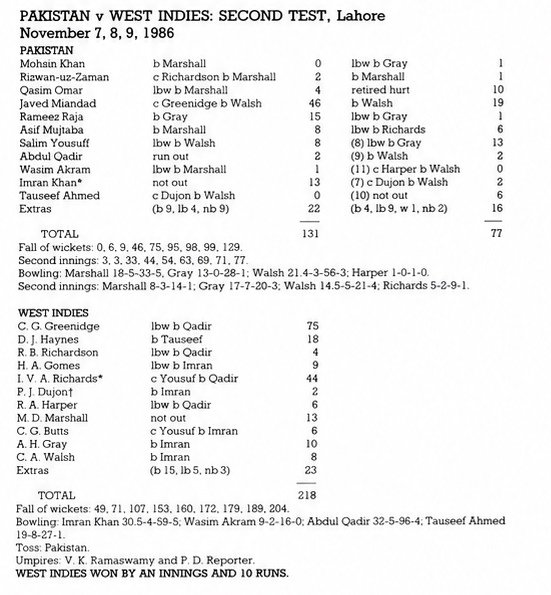
Marshall’s Quickstep, delivered swift and emphatic revenge for their First Test humiliation, crushing Pakistan by an innings and 10 runs in the Second Test at Lahore shortly after tea on the third day.
The pace attack led by Malcolm Marshall, together with the emerging West Indian fast bowlers Tony Gray and Courtney Walsh, proved so overwhelming that the team’s two specialist spinners, Clyde Butts and Roger Harper, shared just a single over between them throughout the entire match. Ironically, the only wicket claimed by a West Indian spinner was that of Pakistan’s teenage debutant, 19-year-old left-hander Asif Mujtaba, who was playing in place of the injured Salim Malik. His difficult introduction to Test cricket ended unhappily when he was trapped lbw by Viv Richards in the second innings. Altogether, the West Indian pace trio collected 17 wickets on a surface that, if anything, appeared more suited to the craft and guile of Pakistan’s spinners, Abdul Qadir and Tauseef Ahmed.
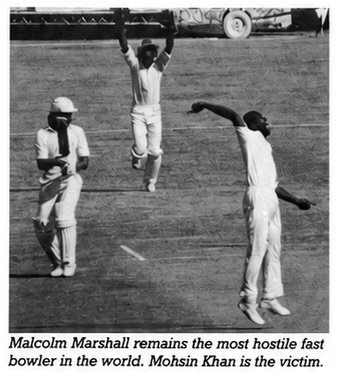
Although the pitch began offering turn from the opening day, not even Qadir could recreate the match-saving heroics he had produced in the First Test after Pakistan’s batsmen were once again dismissed for a meagre first-innings total. Mohsin Khan fell to the fourth delivery of the match, extending his worrying loss of form, and after just half an hour Pakistan, having chosen to bat first, had slumped to nine for three, with Malcom Marshall accounting for all three wickets. Malcolm Marshall remains the most hostile fast bowler in the world. Mohsin Khan is the victim.
Only Javed Miandad displayed the determination and sound technique needed to withstand the outstanding fast bowling of Malcom Marshall and Courtney Walsh. He occupied the crease for 192 minutes, struck only three boundaries during his patient innings of 46, and eventually became the most valuable of Walsh’s three wickets. Imran Khan, who had been battling illness in the days leading up to the match, came in at number 10 and helped add the final 30 runs. An hour into the second day, Gordon Greenidge and Desmond Haynes placed Pakistan’s modest total into perspective with a partnership of 49, which ultimately stood as the highest stand of the match.
The early departures of Desmond Haynes, Richie Richardson, and Gomes forced Greenidge and Richards to rebuild cautiously. Although Qadir and Imran gradually worked their way through the middle and lower order after Greenidge’s lengthy innings ended with him being trapped lbw for the third consecutive Test innings, the West Indies still secured a first-innings lead of 87.
At the conclusion of the match, Pakistan captain Imran Khan remarked that he believed his side might have had an opportunity had they begun their second innings positively. Those hopes, however, disappeared almost immediately when Gray and Marshall dismissed both openers with only three runs on the scoreboard. The situation deteriorated further as Qasim Omar was forced to retire hurt after being struck in the face by a bouncer from Courtney Walsh, while Rameez Raja and Asif Mujtaba both fell lbw in quick succession. Gray and Walsh shared seven wickets as Pakistan were bowled out for their lowest-ever total against the West Indies.
For their part, the West Indies managed just 218, the third-lowest total ever recorded by a team winning a Test match by an innings. The match also marked a historic milestone for the officials, as India’s V. K. Ramaswamy and P. D. Reporter became the first umpires to officiate in a Test match that did not involve their own country.