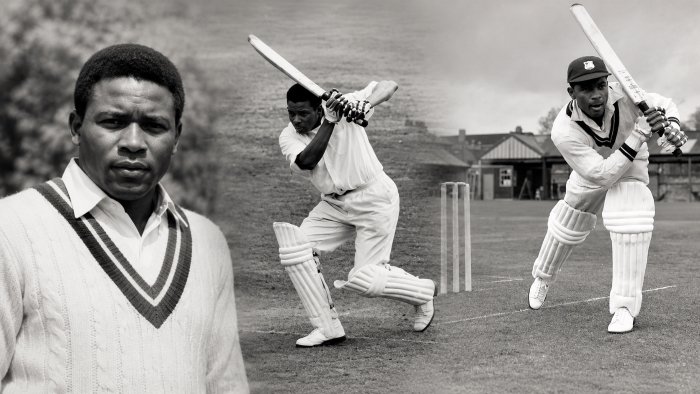
Neither the cricket grounds of Lancashire nor those of the West Indies, nor indeed any other part of the world, will see Collie Smith in action again. His tragic death following a road accident in Staffordshire last September removed from the cricket stage not only a player of wonderfully joyful temperament, but also one of the rarest combinations of gifts with which the modern first-class game has been blessed. For Collie Smith, despite the exuberant pleasure he gave to crowds wherever he played and the sparkling vitality he always displayed, was a remarkably gifted cricketer in his own right—good enough to perform at the highest level even if the exuberance and the smile had not been part of his make-up. But they were, and because of that he was able to add to his exceptional natural ability an adventurous approach to the game in which he took enormous delight, particularly when driving the ball with tremendous force, as much for his own enjoyment as for that of the spectators.
As a hitter, “Collie” Smith was certainly no wild and hopeful smiter. His attacking play was marked by controlled power, identifying him first and foremost as a batsman of genuine quality. He demonstrated that quality emphatically by scoring hundreds in his first Test matches against both Australia and England, despite facing bowlers such as Lindwall, Miller, Statham and Trueman. He was perhaps one of the few batsmen who came close to possessing the qualities of the immortal “Croucher,” G. L. Jessop. Although Smith could not equal Jessop’s breathtaking rate of scoring, he combined the capacity to strike the ball hard, long and powerfully with a genuine and unquestionable standard of batsmanship.
In every form of serious cricket, from the days when he first played for the famous Boys’ Town in his native Jamaica, Smith understood the extraordinary force that could be imparted to a cricket ball through the swift co-ordination of eyes, feet, wrists and sinews. Once a degree of discretion was added to those natural gifts, he could reduce most bowlers to despair. In one match, while still a youth, he watched an opposing bowler deliver seven steady balls in an eight-ball over, before pulling the final delivery high into the sky for six. This style of play, often bordering on the audacious, endeared him to men and boys alike throughout the cricketing world. Even when it occasionally cost him his wicket prematurely, he remained admired and respected as a batsman capable of changing a match.
It was his exploits against the Australians during the season of his first-class début in 1954-55, when he played in a Test match less than two months after making his first appearance for Jamaica, that carried Smith’s fame around the cricketing world. Great names held little fear for him, and in the first innings he ever played against the formidable Australians—in which he amassed 169 runs—he struck a tremendous six off W. A. Johnston, sending the ball over the little red-roofed cottage where Ivan Barrow once lived beside the Melbourne Park arena. In a trial match before the Australian game, Smith made a rapid 108, including 15 runs from one over off Sony Ramadhin, a punishment very seldom inflicted on the little Trinidadian.
In only his second first-class match, for Jamaica against Trinidad at Kingston, Smith guided his side to victory against the clock with an unbeaten 58 in 57 minutes. Of those 58 runs, an extraordinary 54 came in boundaries—nine fours and three sixes, the last of them being the winning stroke. It was during that season that the Australian critic R. S. Whitington, of the Sydney Telegraph, wrote that he had witnessed the birth of another Don Bradman. If his judgment of Smith may have been formed rather hastily, it nevertheless revealed the enormous impression the young, stocky Jamaican had already made. As far back as 1952, when Smith was still virtually unknown beyond his immediate cricketing surroundings, Ivan Barrow had been so impressed by his natural ability that he declared without reservation that “if there is ever to be another Headley, Smith is the one.”
It was certain that, when the time came to select the West Indian side to tour England in 1957, Smith’s name would be included. He had already toured New Zealand and, in the Test match at Dunedin, helped Everton Weekes race to 50 runs in 25 minutes. During the season immediately preceding the English tour, Smith enjoyed phenomenal success in the six important matches he played in the West Indies, scoring no fewer than 731 runs at an average of 81.22. He also, incidentally, claimed 24 wickets, including the wickets of T. W. Graveney and D. V. Smith on three occasions each. In the first innings he ever played on the Bourda ground at Georgetown—in the Inter-colonial Quadrangular Tournament of October 1956—he scored a crucial 109, including two characteristic sixes, the second disappearing into the schoolchildren’s stand, much to their particular delight.
And yet his captain, Alan Rae, pleased though he was with the performance, declared that “Collie was not in real form!” Against the strong side brought to Jamaica by the Duke of Norfolk, Smith struck six sixes in an innings of 118 and altogether hit ten sixes, many of them travelling tremendous distances, in his three matches against the visitors. In one of the trial matches at Port of Spain, arranged to assist in selecting the side for England, Collie Smith went to the tea interval on 78 not out. On the resumption, during the course of a single Jessopian over, he passed his century by hitting the six successive balls for 6, 2, 0, 4, 6, 6.
And so Smith arrived in England carrying a well-earned reputation for powerful stroke-play and adventurous cricket. In the opening first-class match of the tour, on the beautiful ground at Worcester, he began his first-class scoring in England in typically emphatic fashion by hitting Berry for six. He then added two further sixes to his innings of 68, and when he was eventually dismissed—caught on the long-off boundary—the ball had been struck with such force that the unfortunate fieldsman, Outschoorn, suffered a split finger while completing the catch. This marked the beginning of an exciting tour for Smith, during which his fierce hitting was witnessed on almost every ground where he appeared.
Special mention should be made of one or two matches, beginning with the game against Nottinghamshire at Trent Bridge at the end of May. The first day’s play was dominated by Garfield Sobers, who scored a double-century. Shortly after six o’clock, however, Smith walked out to join him at the crease, and in the final 55 minutes of play he actually outscored Sobers, who had been there since the first ball was bowled, by contributing 67 of the 117 runs added. The aggressive pair scored their side’s last 88 runs in 40 minutes, with the total advancing from 401 to 431 in only ten minutes. In the second innings Smith produced an even more remarkable display—one of the fastest innings in the history of the game—scoring 46 not out, including two sixes and six fours, out of the 50 runs added while he was at the crease, and doing so in only 12 minutes. During this astonishing spell, Asgarali, who had been firmly established on 126 when Smith came in, managed to score only four singles.
Later on the tour, at Chesterfield, Collie Smith played one of his most spectacular innings, making 133 against Derbyshire. In addition to eighteen fours, he struck four soaring sixes, one of them off Gladwin, which shattered five tiles on the pavilion roof, while another landed on the concrete shore of the boating lake. Two more fell among the crowd, who were crouching for safety near the sight-screen. In his next match, Smith scored his magnificent 168 against England at Trent Bridge, when one of his sixes, struck off Jim Laker, again broke some tiles, this time on the roof above the ladies’ balcony over long-on.
At the end of the tour, in the festival games, Smith continued to play with great abandon. At Hastings, against L. E. G. Ames’ XI, his 79 came at more than a run a minute in 24 scoring strokes, including six hits for six, two of which went out of the ground. In his first and only appearance at Scarborough, he brought his first-class tour to a fitting conclusion in the same manner in which he had begun it—by opening his account with a six, the ball soaring high into the packed gallery.
It may be interesting to record some of the fastest partnerships in which Collie Smith shared during his 1957 tour:
- 47 for the 6th wicket in 20 minutes* with G. Sobers v. Oxford U., Oxford
- 50 for the 4th wicket in 12 minutes* with N. Asgarali v. Nottinghamshire, Nottingham
- 79 for the 7th wicket in 55 minutes* with F. M. Worrell v. Essex, Ilford
- 89 for the 5th wicket in 60 minutes with F. M. Worrell v. Cambridge U., Cambridge
- 93 for the 3rd wicket in 40 minutes with G. Sobers v. Sussex, Hove
- 100 for the 4th wicket in 38 minutes* with C. L. Walcott v. Kent, Canterbury
- 107 for the 4th wicket in 68 minutes with R. Kanhai v. L. E. G. Ames’ XI, Hastings
- 117 for the 4th wicket in 55 minutes* with G. Sobers v. Nottinghamshire, Nottingham
As was to be expected, Smith’s vitality and attacking approach attracted the attention of clubs in the Lancashire League. He joined Burnley in 1958 on a two-year contract and quickly established himself as one of the League’s most popular professionals. “He is happy hitting 4’s, but happiest hitting 6’s,” said Bruce Pairaudeau, the West Indian batsman and former Burnley amateur. The Lancashire crowds were certainly not disappointed. Some of Smith’s blows were historic and would remain in the memories of the League enthusiasts who witnessed them.
Last May, he produced what was described as the biggest hit ever seen at the Turf Moor ground, Burnley. From the Belvedere Road end, he struck a tremendous soaring drive that carried over the stand and into the centre circle of the adjoining football field. With that prodigious blow, he joined the “immortals,” those illustrious few—not more than four in number—who had accomplished such a remarkable drive. In the same dynamic innings, against Accrington, he hit another six over the wall and out of the ground and reached his century in only 78 minutes, enabling his side to win a hectic race against the clock.
On the following day he scored yet another hurricane century, bringing his total for the weekend to 215 without being dismissed, against Lowerhouse at the West End ground. On that occasion he struck one ball with such force that he cracked the bat. He also played an on-drive that smashed through a pane of glass in a window of the tea-room, no doubt startling the many occupants inside at the time. He once also hit a ball over the houses at Bacup.
But for sheer prolific scoring, Smith will be best remembered for his astonishing innings of 306 not out for Burnley in a Worsley Cup match against Lowerhouse at their West End ground last June. It was one of the most remarkable displays of sustained hitting ever witnessed on a Lancashire League ground, and the popular West Indian easily surpassed the previous record score by a Lancashire League player—225 not out by Everton Weekes for Bacup against Rawtenstall in 1958.
During his astronomical innings, Smith frequently kept youngsters busy retrieving balls that he had struck out of the ground. On two occasions, the ball entered an adjoining park three times in succession. He was given several chances during his innings—which was the first time he had reached a double century in any class of cricket—but such was the force behind his drives that it probably saved him from being caught. He was credited with 56 boundary shots, all of them fours, because there were no sixes on Lowerhouse’s small ground. Had sixes been possible, his already extraordinary total would have been even more gigantic. By Irving Rosenwater