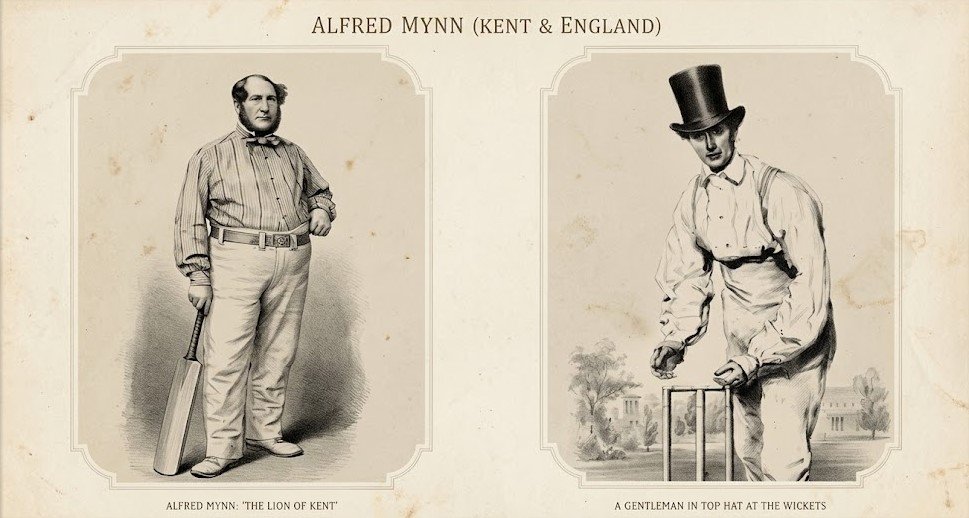
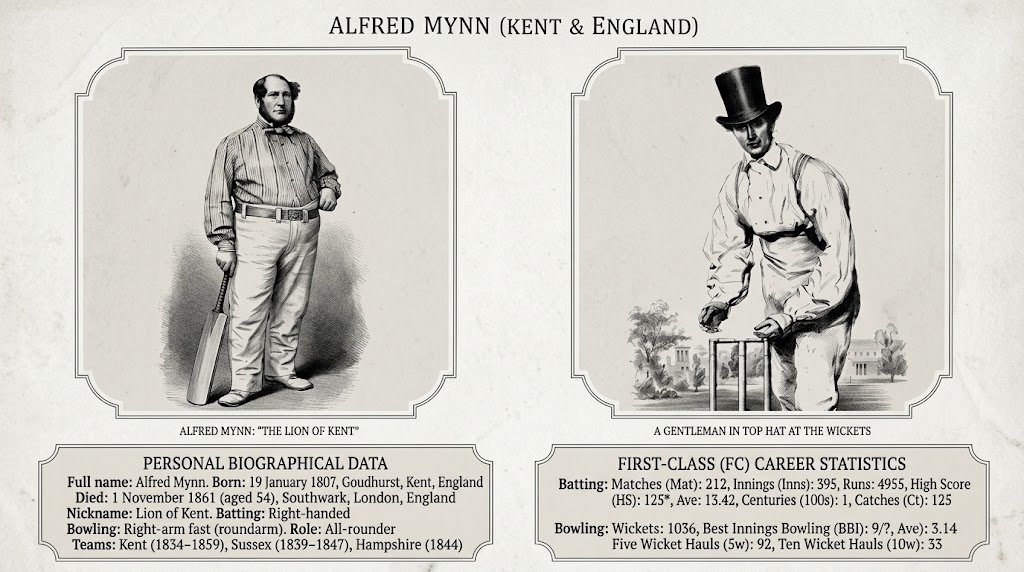
Alfred Mynn, born of pure Kentish yeoman stock, was the pioneer cricketer to achieve nationwide idolatry during the game’s formative years. His impressive physique and warm, approachable personality earned him an enthusiastic following—not only among eager youngsters who closely shadowed his steps, but also among adults who cherished his every move. Standing a commanding 6 feet 1 inch tall and weighing 18 stones, he loomed over his fellow players with splendid proportions.
Born at Twisdon Lodge, Goudhurst, Kent, in 1807, Alfred first picked up a cricket bat in nearby Harrietsham at the age of 18. Around this time, John Willes was campaigning to legalize shoulder-height bowling deliveries—a cause brought to fruition largely through Alfred’s immense skill and popularity. Veteran cricketers often recalled with delight how majestically Alfred glided in to deliver his express-pace bowling, usually coming round the wicket. The ball moved sharply off the pitch from leg-stump toward off. Yet, even during this intense era of cricket’s evolution, the fairness of Mynn’s delivery was never called into question.
Alfred’s batting was equally captivating. His powerful driving and leg-side hitting were delivered with graceful movement and natural execution. Held in his enormous hands, the bat looked almost toy-like, and he always appeared far more comfortable facing fast bowling than slow—primarily because his shot selection lacked broad variety. Hillyer and Redgate, two leading speed merchants of the era, rated Alfred as the most dangerous hitter they ever faced. When fielding, he stationed himself at short slip, where one of his leg-of-mutton hands was considered ample to gather any catch offered in his direction.
On December 15th, 1828, Alfred Mynn married Sarah Powell at Trinity Church, Newington. Their union was blessed with five daughters in rapid succession. During this busy period, Alfred joined the Leeds Club and played his first match in 1829, though with modest success.
The year 1833 marked the first major milestone in Alfred’s cricketing journey when he was selected, from relative obscurity, to represent the Gentlemen against the Players at Lord’s on August 27th and 28th. Although the Gentlemen lost by an innings, Alfred took one catch and claimed four wickets. This marked the true beginning of his legacy; playing alongside the Gentlemen of Kent, he quickly established himself as a premier Kentish amateur. Kent contested their county fixtures at Chislehurst, and late in the season, the Kent Gentlemen took on the formidable Gentlemen of England. The national side won by nine runs, but despite stepping up to a higher standard, Alfred managed to bowl out three batters in the first innings and four in the second.
Some cricket historians have praised the Kent team from the middle 1830s through 1850 as the finest County XI ever assembled. Featuring household names such as wicket-keeper Wenman, Hillyer, and the Norfolk-born Fuller Pilch, the team drew immense crowds wherever they played. Walter Mynn, Alfred’s elder brother, served as captain, though he was rarely highlighted in cricket literature.
In 1834, Alfred Mynn shared the field for the first time with Felix, the Surrey artist-schoolmaster who later joined the famous Kent XI and became a lifelong friend. While Sussex and Surrey had long been the dominant counties, Kent now began to overcome all opposition.
When stumpings and catches were first credited to bowlers in 1836, Alfred’s bowling averages saw a substantial rise. That year, he represented the M.C.C. as a given man—a rare honor, given their preference for selecting players from wealthy membership ranks. Facing Sussex at Brighton, he scored a hard-fought 45 in the first innings; during one massive blow, the blade of his bat completely detached from its handle. His second innings brought even greater heroics with an undefeated 92—his highest score in top-level cricket. Sussex won by a narrow 7 runs, but Alfred bowled out nine batsmen during the match.
Earlier that year, word had spread of an upcoming challenge from the North against the South. The first fixture was set for Lord’s, with the return match in Leicester beginning August 22nd. Practicing before the match at Leicester, Alfred suffered a painful blow to the inside of his right ankle. Despite the injury, he batted with the assistance of a runner to score a vital 21 not out. Bowling for the North was Redgate who, alongside Mynn, was regarded as the fastest bowler in England. In the second innings, Alfred was repeatedly struck on the inside of his damaged leg by Redgate. Yet, across five grueling hours, he batted courageously to produce a flawless, chanceless 125—the only century of his career.
Alfred Mynn (1807–1861): The Lion of Kent Who Revolutionized English Cricket
The South won the match by 218 runs, but at a severe cost. As Alfred staggered from the pitch, he was met by Lord Frederick Beauclerk, who stood shocked that Alfred could even remain upright.
A horse-drawn stagecoach was summoned to convey him to his lodgings, and from there he was quickly taken to London. Due to his immense size and a severely stiffened leg, he could not fit inside the cabin, so he was secured atop the roof. Following a long, agonizing journey over rough roads, he reached London, too unwell to travel onward to Kent. He checked into the Angel’s Tavern on St. Martin’s Lane before being moved to St. Bartholomew’s Hospital, where surgeons debated whether to amputate his leg. Alfred adamantly refused the procedure. Though the precise length of his hospital stay remains unrecorded, nearly two years passed before he played again.
This was a tragic period in Alfred Mynn’s life. In 1837, both of his parents passed away. After moving his household to Thurnham, his wife Sarah gave birth to a son, who tragically survived for only two hours. Joy returned briefly in 1843 with the birth of another infant, only for the child to pass away six weeks later.
Around this period, pads and gloves began appearing to shield batsmen from the dangerous deliveries of Redgate and Mynn. It is believed Alfred wore padded protection inside his trousers when he resumed playing in 1838. Frederick Gale recalled that a pair of Alfred’s pads was presented to W. G. Grace at the start of his illustrious career. Lord Harris similarly recalled a pair of Mynn’s pads displayed in the Canterbury pavilion, reflecting on how little protection they must have provided.
Alfred Mynn’s next fixture for the Gentlemen against the Players took place in 1839, marking the first of 14 consecutive appearances in the series. The Gentlemen won five times against the Players’ three. Aided by his tremendous speed and the unkempt, uneven pitches of the era, Alfred took wickets regularly. Contemporary players often spoke of the audible hum of the ball as it left his hand. Two long-stops were frequently deployed to assist overworked wicket-keepers, and one secondary long-stop—after taking a strike to the chest from one of Alfred’s thunderbolts—was reported to have spat blood for a fortnight.
Batting in the second innings of the 1842 Gentlemen versus Players match, Alfred scored a solid 46 but absorbed another blow on his old leg injury. With the aid of a dozen leeches to reduce the swelling, he returned to the field and bowled out six batsmen in the final innings.
The 1843 fixture was highlighted by a remarkable one-handed stumping of G. Butler by the Gentlemen’s wicket-keeper, T. A. Anson, off one of Alfred’s blistering shooters. Anson was noted for his ambidexterity; on this occasion, he stumped the batter with his right hand while simultaneously gathering the ball with his left. When the batter turned around to find the wicket intact, he was stunned to be given out.
Individual batting averages were first published in 1840, but bowling figures were not incorporated until 1843. Alfred Mynn topped the bowling tables for the first three years. Although these early statistics were not deemed entirely reliable until Bell’s Life introduced its own standardized averages in 1846, Alfred was consistently featured at the top.
Kent first played at Canterbury in 1841 against England, giving birth to the famous Canterbury Week. The following match in 1842 produced a 74-run victory for England, with Alfred claiming 11 wickets. Unkind rumors from losing Kentish gamblers suggested that the players had thrown the match. The next time Alfred Mynn walked into Maidstone market, he was hissed by the crowd. Connecting Alfred with anything underhanded seems unlikely, as Felix once recalled an incident where a certain Baronet approached Alfred with an unsporting offer. The Kent idol instantly snapped, “Get out of my sight or, Baronet as you are, I am sure I shall be knocking you down.”
Gambling on cricket was commonplace, and many players—much like prize fighters—had their own wealthy backers. Alfred Mynn’s chief patron was Lord Frederick Cavendish. Single-wicket cricket was immensely popular during this era, offering the gentry ample opportunity to wager on their favorites.
Alfred, with his exceptional all-round talent, quickly established himself as a fan favorite and elite performer. After overcoming other skilled single-wicket competitors, he stepped into Fuller Pilch’s shoes when James Dearman of Sheffield issued an open challenge in 1838. The Yorkshireman was comfortably defeated, and following the return match, Alfred was universally recognized as the “Champion of England” at single-wicket cricket. Eight years later, he was challenged by his close friend Felix. This contest seemed impractical given that Felix relied heavily on deflections for his runs, whereas single-wicket rules dictated that only shots in front of the wicket counted, and one foot had to remain anchored behind the crease. Furthermore, the usual two runs counted as only one, making Felix’s challenge a topic of much speculation. In the first match, Felix opened the batting and survived for three hours, facing 262 balls to score 186 off-side hits—a highly commendable effort, though he managed only four runs in total. Alfred knocked those off in just 16 balls.
When a public figure of such grand proportions achieves great success, affectionate titles naturally follow. Alfred was dubbed the “Lion of Kent,”“Alfred the Great,”“The Great Man of Kent,” and “The Kentish Giant.” He bore these titles with ease and never showed malice toward fellow players. On one occasion at Lord’s, Felix was standing at point when he dropped a catch off Alfred’s bowling. Always looking to amuse the crowd with antics, Felix dropped into a squat with his head down and arms wrapped around his knees. Alfred walked down the pitch and, with one hand, hoisted the human “ball” by his jacket collar, holding the joker at arm’s length. Arthur Haygarth, compiler of Scores & Biographies, noted Alfred’s abnormal strength, observing that Felix—though short and stocky—weighed around 11 stones.
Among the leading batsmen of the era were two amateurs who enjoyed notable success against Alfred. The first was William Ward, who handled Alfred’s speed from 22 yards with ease by using professional bowlers to bowl to him from 19 yards. The second was the Hon. Robert Grimston, who solved the problem by bringing two bats to the crease. When facing other bowlers, he used a lighter bat; when Alfred came hurtling down to bowl, he switched to a heavier model he named “Mynn’s Master.”
The 1845 season proved difficult for Alfred, primarily due to financial troubles. His name was missing from fixtures during the first half of the season, and rumors of his imprisonment for debt were not unfounded. A document in the Kent County Council archives records his bankruptcy, followed by a jail sentence. An official arrived with an arrest warrant during a match between The Western Counties and the M.C.C., though he was permitted to finish the game before being escorted to Wilton Jail. Alfred’s occupation was listed as Hop Merchant, though there is speculation that officials confused him with his brother, who worked in that trade. Alfred was generally viewed as a suspect amateur, as he played cricket regularly while maintaining a large family. However, he retained a strong following among wealthy supporters who gambled on his matches, and it is likely these patrons posted his bail to keep him on the cricket field.
During 1846, the celebrated Nottinghamshire cricketer William Clarke formed the All-England XI. Apart from playing, Alfred Mynn was elected to the managing committee—perhaps another source of financial support. Alfred generally batted lower in the order but delivered several memorable innings. With the arrival of the railway, the touring All-England XI was lavishly entertained by local societies. This high standard of living suited Alfred, who often remarked that he normally subsisted on beef and beer. When asked what else he trained on, he smiled and replied, “Beer and beef!”
Cricket artist Corbet Anderson recalled the time Alfred sat for his portrait. The session lasted two and a half hours, during which Alfred consumed two full meals, each consisting of two and a half pounds of beef and a quart of beer. Ale seemed to serve as a constant lubricant for tuning his massive frame.
When Butler Parr, a Nottinghamshire maltster and brewer, hosted the All-England XI at his home, Alfred refused to drink beer from a standard glass. Instead, he used two small glasses, keeping one constantly filled. He was known to take ale to bed with him, and even while asleep, he could not be kept quiet. Richard Daft recalled how Alfred’s thunderous snoring from an adjoining room kept him awake all night. On another occasion while staying at a hotel, a four-poster bed collapsed under his enormous weight in the middle of the night.
Alfred Mynn was granted a benefit match in 1847 when Kent played England at Lord’s on July 26th and 27th. His immense popularity and outstanding debts were the primary reasons for this gesture. He bowled out seven English batters in their first innings and scored 48 out of 70 in Kent’s first innings. When Alfred hit the winning run for Kent, the crowd erupted in celebration. Given the participation of leading players and a hardworking committee, the sum raised was believed to be substantial, though the final figure was never publicly disclosed.
By 1848, journalists and observers frequently noted that Pilch, Felix, and Alfred Mynn were past their prime. Alfred had reached 40 years of age and weighed roughly 22 stones. By 1852, the Kent side began to decline in stature, and Alfred’s bowling became less frequent and effective.
The year 1851 was particularly painful for the genial Alfred, as two close family members passed away. In March, he lost his second daughter, Mary Ann, aged 20. Nine months later, his fourth daughter, Eliza Susannah, passed away shortly after being institutionalized. Alfred was a deeply religious man, and this period brought immense grief. Felix recalled that Alfred prayed fervently while surgeons debated amputating his leg years earlier, and noted that Alfred always carried his prayer book in his luggage while on tour.
Up to 1856, he played only sporadically and became affiliated with the Southgate Club—later to become Middlesex C.C.C.—which was founded by the Walker brothers. His friendship with the Walkers was deep, and he received financial assistance from this generous family.
William Hillyer, another great fast bowler for Kent during Alfred’s era, was granted a benefit match due to his premature retirement from ill health. An England XI played 18 veterans at The Oval in August 1858. A brief, touching moment occurred when Alfred and his old colleague, E. G. Wenman, left the field following Wenman’s dismissal. As he passed, Alfred grasped his hand and said: “Goodbye, my fellow cricketer. We have played many a happy match together and now our career is over.” The veterans lost the match, but a welcome £400 was raised for Hillyer and his family.
Playing a few matches for Southgate and umpiring for the All-England XI brought Alfred to a turning point in Kent cricket history. He served on the committee that formed the new Kent County Cricket Club in 1859, following dissatisfaction with the old organization. That same year, Alfred joined the newly formed Leeds and Hollingbourne Volunteers to help combat the threat of Napoleon III from across the English Channel.
In early January 1861, William Hillyer died aged 47. Alfred, alongside his brother Walter and Edgar Willsher, followed the coffin to their friend’s early grave. Later that year, English cricket lovers were saddened to learn of Alfred’s sudden death, caused by diabetes. There had been no prior hint of ill health when he passed away at age 54, but the game lost one of its grandest figures. When Felix was informed of Alfred’s death, he wrote: “One of the noblest specimens of manliness and courage combined with all that was becoming in a man.” Many heartfelt tributes were paid by scribes and players, fittingly summarized by one observer: “…he was a great and lovable man to have known.”
Alfred Mynn was accorded a military funeral by his comrades in the Volunteer Group. As rain poured down, three volleys were fired over his grave. Beneath a yew tree in a corner of Thurnham churchyard, a solid headstone marks his resting place. With contributions steadily arriving, a committee was formed to distribute surplus funds to deserving Kent cricketers who had fallen on hard times.
In Memoriam
Written by the promising sports writer W. J. Prowse, illustrating the loss to English society caused by the death of Alfred Mynn in admirably descriptive verse. The last line sums up the lament of Alfred’s aggrieved followers for their hero:
“Lightly lie the turf upon thee, kind and many Alfred Mynn”