A beautiful piece of history on how cricket transformed Victorian England, influencing society, sportsmanship, and British culture.
In this year of grace, 1897, all the British Empire is joining together to congratulate her Gracious Majesty, Queen Victoria, upon the unparalleled duration of her reign. There is no part or condition of her loyal subjects’ lives which may not fairly be called upon to prove its right to be regarded as one of the blessings her Majesty may associate with her happy occupation of the throne of England.
The rise and development of athleticism, until it has become a most important aspect of British life, has been one of the marked characteristics of the Victorian era. I do not mean to say that the nation had not athletic tastes and tendencies long before Queen Victoria ascended the throne in 1837. That would be untrue. For, from time immemorial, the English have been passionately fond of sports and pastimes, and have carried their love for them wherever they have wandered on their many errands of peace and war. But in former days, games of all kinds were offshoots and ornaments of daily life rather than distinct and absorbing interests. It is during the last sixty years, and especially during the latter half of this period, that the two great games—cricket and football—have become such enormous factors in the sum of English life.
It may also be said that the average modern Englishman has two separate sides to his nature—one for work and one for games. And though his work may sometimes make it impossible for him to play games, though his interest in games may sometimes prevent him from working, still, if an average be struck, the two sides will be found fairly well balanced. At any rate, games form a very large part of modern English life. Queen Victoria reigns over a people who find much of the pleasure of life in games, either actively or passively.
In reviewing a period about its value in a nation’s history, it is a great mistake to leave out of the reckoning the recreations and pleasures of the people, for these have a considerable influence on the national character. And the larger share such things have in daily life and interests, the more important it is to consider them. So, in casting our eyes back upon Queen Victoria’s reign, we must not omit to notice the prevailing spirit of athleticism, which, if it existed before, has only of late years assumed a definite shape by crystallising, as it were, round the two great English games, and round others in a less marked degree.
Foreigners who come to England are always surprised and impressed by the deep and widespread interest in games. A German friend of mine once said to me:
“When I first came to England I was naturally on the look-out for such traits and characteristics as were different from those of my own countrymen. Nothing struck me as more peculiar in external English life than the extraordinary interest taken in games, and the exaggerated importance, as it seemed to me then, attached to them by the public. I could understand people liking football and cricket, but I could not understand how they could bring themselves to make these games integral and absorbing portions of their life.
“The way I first perceived what games mean to Englishmen was this. I was taken by a young Oxford graduate to see a cricket match at Kennington Oval. To begin with, I was much astounded at the enormous seating area of the ground, and at the huge crowd that was assembled to watch eleven men from Nottingham play at bat and ball against eleven men of Surrey. But what seemed to me hardly credible was the extreme orderliness of the many thousands as they came and went through the turnstiles or stood in their places round the ring. And yet there were only four or five policemen on the ground. These, too, had nothing much to do. They seemed chiefly occupied in finding some spot to stand where they could see the match well without obscuring any one’s view.
“I remarked on this to my friend, and told him that abroad it would require at least three hundred policemen to keep such a huge crowd in order.
“‘Ah!’ he replied, ‘but all these people come to see cricket, and when they get here pay no attention to anything but the game. So they sit still and don’t interfere with one another.’
“Then I saw how deeply the English are interested in games.”
My German acquaintance’s remarks are instructive. Something that keeps 25,000 people in order without external direction or suppression must be very real. I am afraid large bodies of spectators are not always quite so well behaved as on this occasion. But that they behave as well as they usually do is surprising enough till the reason is recognised.
The mention of foreign criticism of English games reminds me of an article I saw in the New Review last summer. The writer of it tried to show that the games and pastimes upon which the English pride themselves as having contributed largely towards the national greatness do not produce, even physically, finer men than Continental military training; that they certainly produce far less valuable citizens, and waste also much valuable time. His point was, as far as I remember, that the three years’ military training which every Frenchman and German has to undergo produces a physical result at least as good as do our games, and with great economy of time. Further, whereas skill in games is of no practical use, a knowledge of military service and its requirements is useful for an extremely important end—the defence of one’s country.
About physical development, pure and simple, I am not in a position to dispute these statements. For I have not seen enough men trained under the military system to afford a fair comparison. But those Frenchmen and Germans whom I have seen certainly fall below the physical standard attained by the average Englishman. As far as I can see, the man who is the result of football and cricket is, in the matter of thew and sinew and general bodily ability, about as good a specimen as can be produced by any means whatever.
However, for the sake of argument, let us regard the two physical results as equal—or, if need be, that of games as slightly inferior to that of military service. In every other respect, there can be no possible doubt: games are far better training for a man than military service.
In the first place, they fit in much more conveniently with the pursuit of employment, whether trade or profession. Nowadays, a young man can get plenty of exercise at football or cricket without in any way spending upon them time which he ought to be devoting to work. Perhaps he may not be able to play enough to become a first-rate performer, or to win any fame as an athlete, but he can play enough to cultivate his physique quite as highly as desirable.
Military training, on the other hand, cuts a man’s life in two. To meet its requirements, he has to leave his trade or profession for several years, which must handicap him immensely and is likely to render him far less efficient in his particular line than he would otherwise be. Military training comes all in a lump; training by games is spread over many years. The former ends suddenly and forever; the latter goes on as long as a man retains the power of running and a fair use of his limbs.
Moreover, it is quite obvious that the general atmosphere of cricket and football fields is for a young man far preferable to that of the barracks. Barrack life is at best rather unsavoury—at least so it seems to me. I can well understand that three years spent in it may do an infinite amount of harm, whereas a playing-field cannot possibly do any one any harm, but only good.
But to return to the respective results. Given that the two trainings produce practically the same purely physical result, you have not thereby made sure that one does not produce a far better man than the other. Now I maintain that the training by means of games turns out to be by far the better method.
The oft-repeated saying of the Duke of Wellington—that the Battle of Waterloo was won on the Eton playing-fields—has a deeper meaning than is usually attached to it. Games do more than strengthen muscles and teach courage and endurance. They give those who play them an unconquerable joie de vivre—a buoyancy that refuses to be overwhelmed.
It is this pleasure in life, these eternal good spirits, that, in addition to courage, endurance, and physical powers, are the great benefits England has reaped, and is still reaping, from her love for games. And herein is one of her most fruitful resources.
Mr. Andrew Lang, in his unerring manner, has hit the nail exactly on the head. And what he says of cricket applies also in some degree to other games:
“Cricket is a liberal education in itself, and demands temper, justice, and perseverance. There is more teaching in the playground than in schoolrooms”—he might have added, than in gymnasiums or drill-yards—“and a lesson better worth learning often. For there can be no good or enjoyable cricket without enthusiasm—without sentiment, one may almost say; a quality that enriches life and refines it; gives it what life more and more is apt to lose—zest.”
No one ever got much enthusiasm or zest out of parallel bars or squad drill. It is just this that makes all the difference. Physical training by means of games has all the advantages over that by means of military service, which the voluntary and pleasant has over the compulsory and distasteful.
In the former, the subject can give full play to his instincts and becomes himself; in the latter, he is checked and curbed and pressed into a mould. And the instincts to which games give scope are some of the best in human nature. Cricketers and footballers are far more likely to realise their possibilities for good than are hastily trained soldiers.
As to who makes the better citizens, it may be safely concluded that the better men do—unless they are required for a European war, a contingency to which Englishmen are happily not in much danger of being subject.
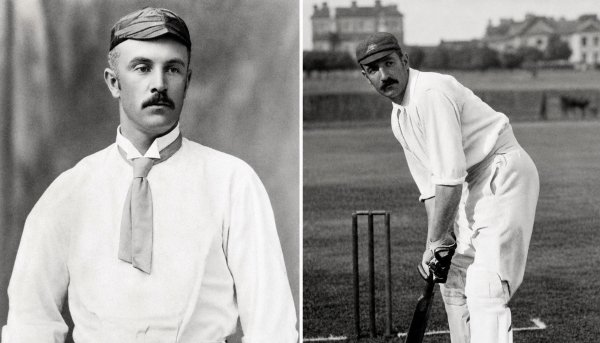
Well then, athletics have come to be a very large part of English life, definite forms of athletics. For proof of this, statistics suffice. Not that I mean to deal in figures. The huge numbers recorded as having visited cricket, football, and other matches; the variety and circulation of sporting journals; and the general prevalence of athletic literature of all sorts show that games are with us in some bulk. And games are good, for they produce good results and make, almost without exception, what is good.
The next point I should like to make is that cricket is the best of all games, and is so regarded by the majority of Englishmen all over the world, best intrinsically as a game, and also because of its effects upon those who play it or watch it being played.
What says Richard Daft, one of the most skilful and thoughtful of cricketers?
“No game except cricket combines a great amount of science with the advantage of bodily exercise. In fact, the mental and physical qualities required for one who would excel as a cricketer are about equally in demand.
“When one is at the wickets batting, the brain is never at rest—eye and hand must work together. The bowler is your enemy for the time being, to say nothing of the wicket-keeper and fielders; your enemy is doing all he can to overcome you, and you must bring all your mental and physical qualities into play to prevent him.
“The games of lawn-tennis, football, baseball, lacrosse, and others are all of the same class as cricket, but none of them allow of such exact science as our national game.
“A single mistake on the part of a batsman may cause his downfall, whereas at every other game more mistakes can often be made without the like disastrous consequences to the player who makes them.
“Then, of course, we have an advantage over football in having a most enjoyable time of the year for our game. The surroundings of a cricket-match are naturally of a pleasanter character. I am very far from running down our chief winter pastime. Football is, in my opinion, by far and away the finest game ever known, with the one exception of cricket.
“Cricket has also this great advantage over many games—by having eleven men on each side. This must always make a game more interesting than where there are only one or two on a side. When we have eleven-a-side contests, we know that a match is never lost till it is won, and a seeming defeat is often turned into a victory by the tail-end at the eleventh hour.
“Cricket is the king of games for players, as it is for spectators who understand the game. For those who do not, I can quite understand their considering it slow and uninteresting.
“And now that I have gone through the whole of my career down to the present time and look back to the time I was a young man, I am far from regretting that I have been a cricketer; and he who has never indulged in this noblest of all pastimes, be he prince or peasant, has missed one of the greatest enjoyments of life.”
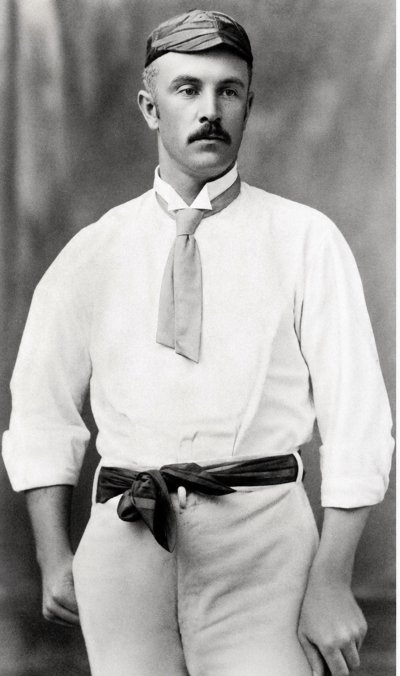
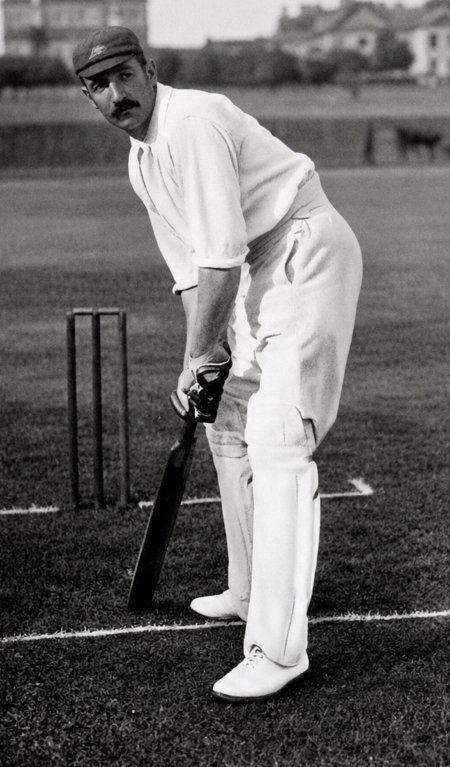
Such is Richard Daft’s opinion of cricket, and I think it will be echoed by all who have either taken part in the game or had much to do with it. How cricket compares with sports is another question. Many fine cricketers like hunting, shooting, or fishing better than cricket. But no one who has played most of the English games with fair success has really any doubt in his mind that cricket stands by itself as the best of them all.
The opinions of men who have risen to a high position in other games but have failed in cricket must be accepted with some reservation. Many men have played football and cricket equally well, but none of those whom I know has the slightest hesitation in plumping for cricket as the better game of the two.
It is always difficult to analyse a game with a view to finding out why it gives pleasure. Richard Daft seems to me to go to the root of the matter concerning cricket when he says that it requires of its followers a high degree not only of bodily but of mental skill, and exercises both in a very pleasurable way.
But there is something in the game of cricket which cannot be expressed in words—a peculiar charm and fascination. It is as impossible to describe this as it is to describe the pleasure derived from seeing fine trees or fine buildings. All one can say is that the charm of the game consists of an aggregate of pleasant feelings which is greater than that given by any other.
And I think the reason must be that cricket calls into play more faculties, and gives them freer play and wider scope, than any other game. This is what a cricketer means when he says there is so much in the game. People who have not played or been closely concerned with cricket have not the faintest conception of what there is in it. In a somewhat similar way, those who have no acquaintance with music fail to understand what there is in a sonata of Beethoven.
It has sometimes been objected that nearly all the pleasure derived from cricket is due not so much to the intrinsic merits of the game as to accidents of conditions and surroundings. That bright June sunshine and fine green turf are good settings for a game no one can deny. Then there is that grand old elm yonder to lie under while looking on. And there is all the pleasant companionship and salted wit of the pavilion and the railway journey.
But I cannot help thinking that it is the spirit of cricket—the game itself—that glorifies everything connected with it. No doubt, when people play the game on a rough jumble of veldt-grass and mine-tailings in the outskirts of Johannesburg, half the pleasure they find is the result of the association of ideas. The feel of a bat and its sound against the ball bring back memories of the green turf and cool breezes of England.
Still, cricket is a gem fair in itself, apart from the beauty of its setting—a gem quite worthy of a niche in Queen Victoria’s crown.
Read More: John Reid: Disciple of Aggression (1928–2020)