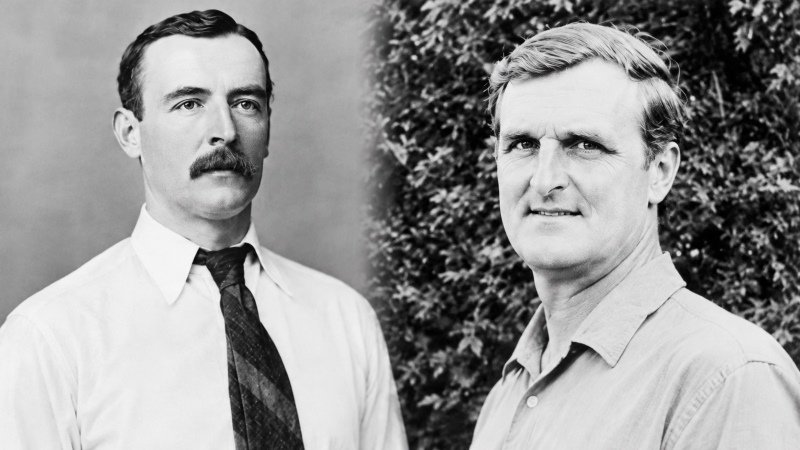
Through the years, cricket has been fortunate to produce retired players who have willingly devoted themselves to the game’s administration at the highest level. Few were more dedicated than Alexander Josiah Webbe. With his friendly disposition and cheerful approach, he continued the excellent work begun by I. D. Walker and his brothers, particularly in the service of Middlesex cricket. Born in London on January 16, 1855, A. J. Webbe was destined to make his mark on the cricket fields of Harrow as a highly promising opening batsman.
Although he and his elder brother, G. A., represented Harrow in matches in 1872, the latter was unable to secure a regular place in the full school eleven because of ill health. That distinction fell to A. J. in 1872. Haygarth’s M.C.C. Cricket Scores and Biographies describes how the gates at Lord’s were opened at five o’clock in the morning to admit arriving carriages, although horses were not permitted inside the ground.
Around this period, and even many years afterwards, the Eton versus Harrow fixture was a grand social occasion, with elegantly dressed couples strolling around the outfield during intervals. On one particular Friday, more than 16,000 spectators passed through the turnstiles, although members were excluded from this figure because they did not pay for admission on the day. Princes and princesses were reportedly among the spectators, while another 11,000 people watched the second day’s play on Saturday.
1874 Captain of Harrow
A. J. Webbe enjoyed another memorable year in 1873, and in 1874 he was appointed captain. The disappointment of leading the losing side was softened by his magnificent innings of 77 and 80, scored when the respective team totals were only 155 and 145.
During these encounters, a friendly rivalry developed between the celebrated Lyttelton brothers and Webbe. It continued throughout their university careers, although A. J. played alongside the Hon. Edward and the Hon. Alfred Lyttelton for Middlesex. It is doubtful whether Harrow produced a finer batsman than A. J. Webbe before the arrival of F. S. Jackson and Archie Maclaren.
After going up to Trinity College, Oxford, in 1875, Webbe quickly demonstrated his considerable ability and fitness. He produced a remarkable innings of 299 not out against Exeter College, followed by 120 for Oxford University against the Gentlemen of England. These performances undoubtedly helped him secure his Blue as a freshman that same season.
In the Varsity match, Webbe contributed 86 alongside T. W. Lang, a valuable partnership that helped Oxford secure a narrow six-run victory. Another decisive moment came when Webbe took an outstanding boundary catch to dismiss the dangerous-looking Hon. A. Lyttelton towards the end of Cambridge’s second innings.
Although Webbe was elected Treasurer of the Oxford University Cricket Club in 1876, he had to endure a nine-wicket defeat when the two sides met. Oxford made amends the following year, however, gaining revenge with a ten-wicket victory. A. J. Webbe and his brother, H. R., were particularly influential, knocking off the 47 runs required for victory.
Webbe also won the Racquets Championship that year and successfully defended the title the following season, defeating the Hon. Alfred Lyttelton on both occasions. The roles were reversed in 1888, when Alfred claimed the gold tennis racket at Lord’s, leaving A. J. with the silver.
Both university captains, W. S. Patterson and A. J. Webbe, were invited to represent the Gentlemen at the Oval in 1877. Webbe, however, had already made his debut in 1875 and went on to appear in many of the matches against the Players. Cambridge’s emphatic victory in 1878, by 238 runs, was built around impressive contributions of 53 and 64 from Edward and Alfred Lyttelton respectively. Edward then had the final say, producing a brilliant catch to dismiss Webbe. Moving from slip towards the leg side, he scooped the ball up with his left hand.
It must have been a particularly poignant occasion for A. J. Webbe, as he had opened the Oxford innings with his brother, H. R., and was preparing to hand over the captaincy to him for the following year.
Opened the innings with W. G.
Looking back at A. J. Webbe’s rather unfortunate first appearance for the Gentlemen in 1875 at the Oval, his failure was perhaps softened by the fulfilment of a personal ambition: opening the innings alongside W. G. Grace.
The match at Lord’s followed immediately and became memorable for a record opening partnership of 203 in the second innings. Webbe had unfortunately collected a duck in the first innings, but recovered in spectacular fashion. Playing on a damp, lively pitch that offered assistance to the bowlers, he shared the remarkable stand with W. G. Grace, who finished with 152, while Webbe contributed 65.
Webbe’s batting stance could be described as typically Harrovian. He adopted a wide-legged, slightly crouched position, rather like that of Gilbert Jessop. As an opening batsman, he displayed remarkable patience on difficult wickets, combining sound defensive technique with decisive attacking strokes whenever the situation demanded.
His late wrist movements were particularly impressive. He possessed wonderful placement and timing when working short-pitched deliveries away from his body, while his ability to cut the ball late and square was equally effective.
Like I. D. Walker before him, A. J. had a particular fondness for the ‘Harrow Drive’. At the time, this shot was described as a stroke through the covers, although it would now more commonly be recognized as a slash over the head of cover.
His fielding was equally impressive, and he regularly produced outstanding catches from virtually every position on the field. His bowling might best be described as a useful change, rather than a major attacking weapon.
Although his average height and weight gave him no particular physical advantage over his fellow players, the many recollections of A. J. Webbe reveal a man of exceptional character. His generosity and tactful willingness to offer advice reflected a truly commanding personality. On the occasional day when his comments on the field appeared rather impulsive, he was always quick to apologise if he felt that his words or actions had upset anyone. Most people received these occasional outbursts with good humour.
The name A. J. Webbe became closely associated with both Lord’s and Middlesex cricket for many decades. He was one of the most influential figures during the county’s formative years. His first appearance came in the same year that he earned his Blue, in 1875.
This exceptionally promising 20-year-old demonstrated his potential in his second match, when he carried his bat against Nottinghamshire’s formidable bowling attack, finishing with an unbeaten 97. His approach combined attacking strokes with careful defence, and his performances earned him second place in Middlesex’s batting averages at the end of the season.
His first opening partner was I. D. Walker, and together they formed a formidable partnership that continued until Walker’s retirement. Webbe’s next partner was A. E. Stoddart, who remembered the encouragement he received from his more experienced colleague when he first arrived at Lord’s as a confused and lonely young man from Durham.
Webbe was commonly known by his shortened Christian name, Alec. However, his introduction to the Middlesex team brought him the nickname ‘Webbie’, although this was used only by close friends. (I know the feeling myself, as members of my family and I have often been called by the same name in our Hertfordshire village of Redbourn.)
On a rain-affected pitch at Sheffield in 1882, Ted Peate, the leading bowler of the season, and Bates dismissed Middlesex for 135. Even after the opening pair of Walker and Webbe had put together 95 runs, the remaining batsmen struggled badly.
The Londoners were left with a target of just 140 to win this low-scoring encounter. However, Peate dominated the second innings, taking eight wickets for 32 runs and securing a 20-run victory for Yorkshire. Webbe was the only Middlesex batsman to make a substantial impression. He remained unbeaten on 62, batting right through the second innings and never appearing likely to lose his wicket.
Middlesex were fortunate to have A. J. Webbe step into the captaincy following I. D. Walker’s departure in 1885. There could hardly have been a more natural successor. Webbe continued in the position until Gregor MacGregor took over in 1899.
During Webbe’s playing career at Lord’s, Middlesex benefited from the talents of outstanding batsmen such as Stoddart, O’Brien, Ford and Alfred Lyttelton. Although Webbe may have been more restrained in his stroke play than some of these great players, his consistency was unquestionable.
He was always at the heart of the game, whether on the field or away from it. His enthusiasm and engaging personality made him a popular figure with everyone associated with cricket.
Even the finest cricketers have seasons when everything seems to fall into place. For A. J. Webbe, that outstanding year was 1887. Scoring more than 700 runs for Middlesex, he produced two remarkable innings that perfectly demonstrated his batting ability and affection for the game.
The first came against Kent at Canterbury, where he carried his bat for an unbeaten 192. Just a week later, against Yorkshire at Huddersfield, he produced an even greater performance, batting throughout the innings for his highest-ever score of 243 not out on a difficult, fiery pitch.
Yorkshire’s wicketkeeper, David Hunter, had to stand back to deal with the deliveries that rose sharply over Webbe’s head. Rain forced the abandonment of the third day’s play, so the players entertained the spectators with a football match instead!
Webbe’s magnificent 243 remained a Middlesex record until 1899, when C. M. Wells scored 244 against Nottinghamshire at Trent Bridge. During that remarkable 1887 season, Webbe accumulated more than 1,200 runs at an average of 47. Interestingly, those two centuries were the only hundreds scored by a Middlesex batsman that year.
King-pair v. Surrey – 1892
Alongside the more enjoyable memories of a distinguished career, batsmen inevitably recall their disappointing moments. A. J. Webbe must surely have wished to forget his unfortunate ‘king-pair’ against Surrey at Lord’s in 1892, when George Lohmann dismissed him with the first ball of each innings.
Another occasion that must have remained in his memory occurred the previous season, when Nottinghamshire visited Lord’s. With only 30 minutes remaining and five wickets still to fall, the match appeared to be drifting towards a draw. Webbe and Stoddart had put together 95 runs, with A. J. looking well established at the crease.
However, Nottinghamshire captain Robinson decided to introduce Mordecai Sherwin, the 17-stone wicketkeeper who also played in goal for Notts County, to bowl a few harmless overs in the remaining time. Sherwin immediately dismissed Webbe, prompting the other players to leave the field four minutes before the scheduled close.
The Nottinghamshire victory was greeted by stony silence from the spectators.
The 1881 season had provided another difficult experience for Webbe. While representing the Gentlemen of England against Oxford University at Christ Church Ground, he suffered a nasty facial injury on a rough pitch. The match was subsequently restarted on a different surface at the New Ground.
A. J. Webbe’s distinguished playing career finally came to an end with his appearance against Worcestershire at Worcester in 1900. Although it proved to be his only match that season, he delivered an impressive performance. On a difficult wicket, he carried his bat through the final innings, finishing unbeaten on 59 and saving Middlesex from defeat.
A. E. Stoddart also appeared in what turned out to be Webbe’s final county match. Over the course of his career, Webbe had carried his bat through an innings on eight occasions. He scored seven centuries for Middlesex and accumulated more than 14,000 first-class runs, including 14 centuries in total.
‘Plum’ Warner regarded him as a constant source of guidance and frequently turned to him during difficult periods. When Warner became captain of Middlesex, he fondly remembered the warm welcome he had received from A. J. Webbe on his first appearance for the county, much as A. E. Stoddart had experienced earlier.
Warner remained grateful for the advice Webbe gave him and recalled how his friend persuaded him not to retire at the end of the 1919 season. Their friendship was especially rewarding when both men lived to see Middlesex win the county championship the following year.
Webbe toured overseas only once. The opportunity arose when I. D. Walker was invited by the Melbourne Cricket Club to assemble a team of 12 amateurs. To strengthen the bowling attack, however, two Yorkshire professionals, George Ulyett and Tom Emmett, were also included.
The tour did not prove particularly successful for Webbe personally, although he did appear in the Melbourne Test under the leadership of Lord Harris.
Harrow Wanderers were fortunate to have both I. D. Walker and A. J. Webbe organising their tours. Webbe’s own eleven also enjoyed regular fixtures against the Universities. These encounters played an important role in developing and raising the standard of their cricket.
Although Webbe suffered from arthritis and became severely crippled by the condition in later life, his devotion to cricket never diminished. His administrative contribution at Lord’s was immense, and the numerous positions he held reflected the countless hours he willingly gave to the game he loved.
He served as Honorary Secretary of Middlesex and became President in 1922, succeeding another close friend, R. D. Walker. He continued in the position until ‘Plum’ Warner took over in 1937.
Middlesex captains including F. T. Mann, Haig, Robins, Enthoven and Peebles all benefited from his thoughtful advice whenever they sought it. Numerous amateur and professional cricketers gained from his remarkable knowledge and experience.
Webbe became a member of the M.C.C. Committee as early as 1886 and remained a trustee until his death. Yet perhaps his greatest distinction came with his appointment to the Presidency in 1925. Once again, he succeeded R. D. Walker.
In death still at the centre of world cricket
Few men ever devoted more of their time to cricket than A. J. Webbe. Nevertheless, even he found time to help those in need, serving on several hospital committees and contributing to efforts to relieve the suffering of others.
He died on February 19, 1941, at his home, Fulvers Farm, Abinger Hammer, Surrey, aged 86. At the time of his death, he was the oldest surviving Varsity skipper.
Webbe’s remarkable contribution to cricket was commemorated by a portrait painted by Francis Dodd, R.A., which was displayed on a wall of the Long Room at Lord’s. The painting was presented by members of the Middlesex County Cricket Club.
He possessed an extraordinary ability to remember people’s faces, even when he had not seen them for many years. Although he was no longer there, his portrait ensured that cricket lovers would continue to recognise his familiar likeness at the very heart of world cricket.