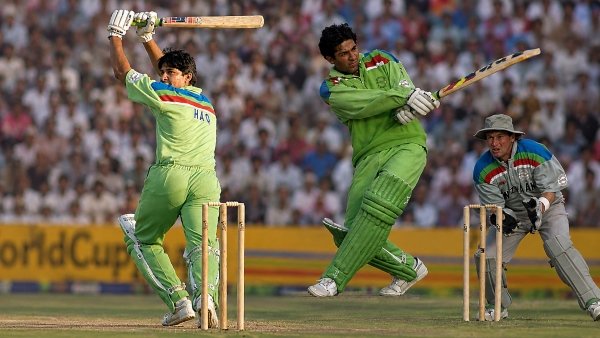
AUCKLAND: Brilliant Pakistani’s strom into 1992 World Cup final
A magnificent exhibition of languid strokeplay by another of Imran Khan’s hand-picked proteges, the 23-year-old Inzamam-ul-Haq, conjured an astonishing Pakistan victory as they reached their first World Cup final. Arriving at the crease with Pakistan needing 123 from 15 overs, with four wickets down and a partisan crowd breaking into the chant of ‘Easy, easy’, Inzamam silenced them by striking a brilliant 60 from 37 balls.
His innings, which enabled Pakistan to overhaul New Zealand’s total of 262 with an over to spare, finally exposed the limitations of the Kiwis’ puffball attack, who had cleverly conned their way through the tournament thanks to a combination of bravado, astute captaincy and lifeless pitches. It also spared the blushes of his captain, Imran, whose laboured 44 from 93 balls had seemed more of a hindrance than a help during Pakistan’s run-chase. No wonder Imran was moved to superlatives in an expansive press conference after the game.
To be fair, Imran upon arrival in Australia six weeks ago had declared that Inzamam was a player of precocious talent, comparable to Tendulkar in ability, if not stature. Yet after eight matches in the tournament he had accumulated just 123 runs at an average of 15.
But by 5.30 he had left the 35,000 crowd stunned by the speed of the Kiwi reversal, while the New Zealand players, as they completed a lap of thanks to their supporters, were desolate and close to tears. Nothing is so devastating as losing a match, especially a semi-final, that has been under control until the final hour.
Martin Crowe’s frustrations were increased because he was just a helpless spectator during the Pakistan run-chase. A torn hamstring, acquired towards the end of his innings, had compelled him to hand over the captaincy to John Wright.
For Crowe, it was a wretched end to a day that had been going according to the meticulous plans that have been a characteristic of the Kiwis’ World Cup campaign. Having won the toss, Crowe chose to desert his favoured policy of chasing because of the ominous weather forecast. From the first over, Mark Greatbatch flailed away, mostly at thin air, though he still managed to club two extravagant sixes, taking his World Cup tally to 14, before being duped by a slow off-break from Aaqib. Wright, recalled partly to combat the leg-spin of Mushtaq, promptly holed out like a novice to long-on, leaving Crowe and Andrew Jones to restore the innings.
Like all great players, Crowe gathered runs imperceptibly, scoring at a run a ball without appearing to play any shots. Mushtaq posed him few problems, but initially tormented his partners: Jones, until he was lbw, and Ken Rutherford.
With Crowe steadily assuming command, Imran decided to gamble by employing his most dangerous bowlers, Mushtaq and Wasim Akram, in tandem to dismiss Crowe and enable his second leg-spinner, Iqbal Sikander, to bowl at batsmen who do not understand wrist-spin. This strategy failed, since Crowe was immovable, and when Sikander was finally introduced in the twenty-eighth over, Rutherford, having taken 21 balls to score his first run, was striking the ball with as much confidence as his captain.
Together they added 107 in 19 overs. Twice Crowe clipped effortless sixes over the short boundary at square leg, as well as sweeping Mushtaq into an ecstatic crowd at midwicket. Rutherford was equally punishing against Sikander, driving him over long-off.
However, in the forty-third over, bowled by Waseem Akram, Crowe’s day began to disintegrate. Rutherford, attempting a hook, skied the ball to the keeper, and as Crowe ran to the striker’s end he felt a twinge in his hamstring. The next time he completed a single he was hobbling desperately. A runner, Greatbatch, was summoned and, in the mayhem of the final assault, Crowe had to endure the additional agony of watching himself being run out nine runs short of a treasured century. His departure did not affect the New Zealanders’ momentum—they scrambled 56 from the last five overs—but already his chances of playing in the final seemed slim.
After 35 overs of the Pakistan innings, though, it certainly looked as if Crowe’s team would be in Melbourne on Wednesday. After Sohail’s early dismissal, Imran, who had promoted himself to No 3 —a testament to his self-belief rather than his form in this tournament—was stifled by the Kiwi medium-pacers. Even though he struck two sixes, his inability to increase the tempo probably led to the dismissals of Rameez Raja, who had contributed a delightful 44, and Salim Malik, who sliced his second ball to cover point.
This left Javed Miandad and Inzamam with a formidable task. Inzamam attacked immediately, while Javed scuttled singles before bellowing countless words of advice to his young partner. No wonder Inzamam demanded his helmet as soon as Morrison was recalled.
Patel, who did not enjoy the rare experience of bowling late in the innings, conceded 22 runs in his last two overs, while Harris, the most unlikely leading wicket-taker in the tournament, was stroked over extra-cover for six. When Inzamam was run out having added 87 in 10 overs with Javed, the target was reduced to 36 from five overs. This was whittled down to 12 from two, whereupon Moin Khan thumped Chris Harris for a six over long-off and then pulled him to midwicket for four. He headed straight for the pavilion, only to be submerged by his teammates rushing on to the field. Even the dignified Imran joined them. In his jubilation, he said he did not care a jot who his opponents were in Melbourne, though later he confessed that “at least if it is England the crowd will be on our side”. The match against England in the 1992 World Cup final will be a massive one.